
Paving Contractor Insurance by State
North Carolina Paving Contractor Insurance
North Carolina licenses paving through its general contractor board, prequalifies road contractors down to the subcontractor, and leaves the choice of sealer to the job.
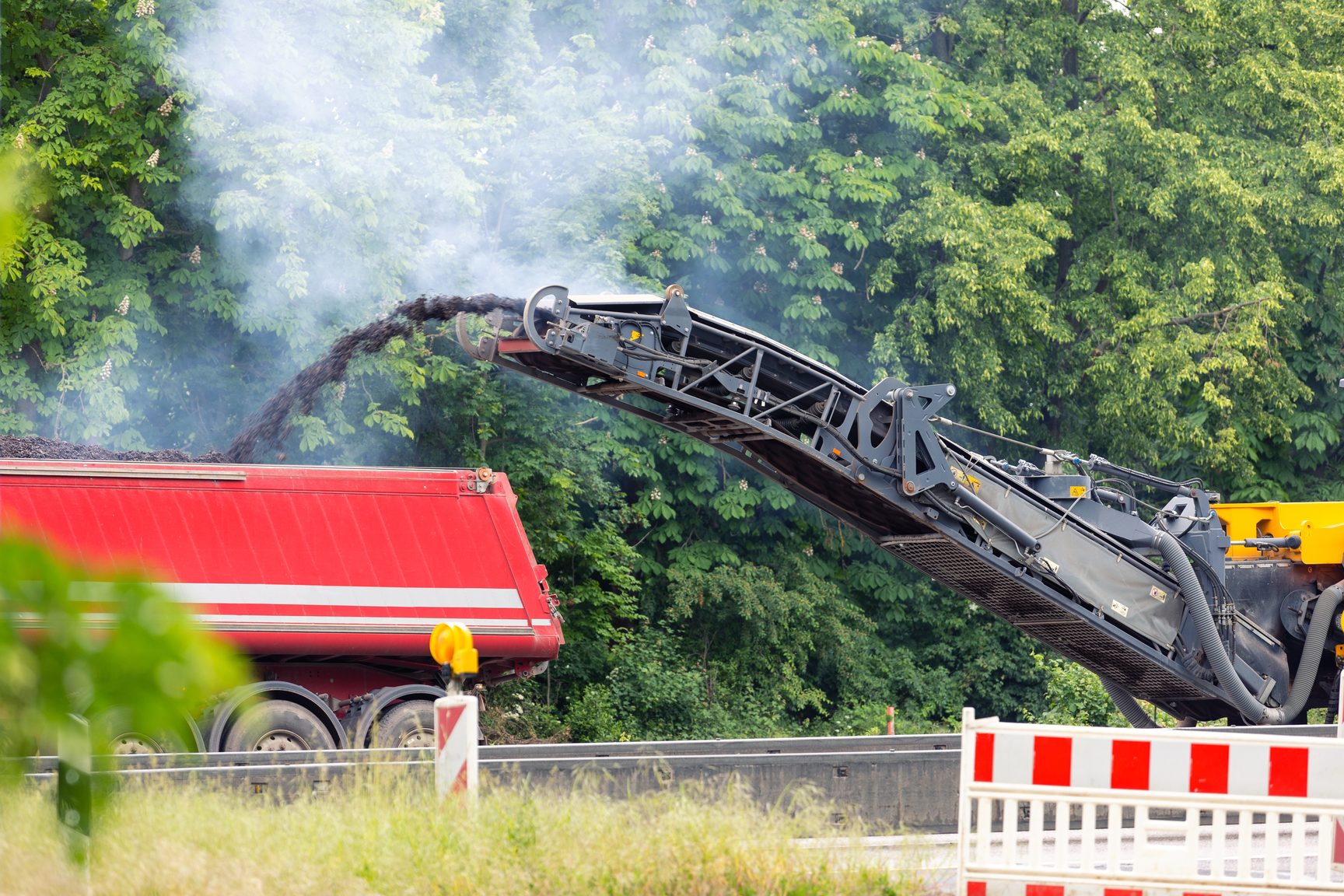
North Carolina paving contractor insurance is built from the lines every asphalt business carries — general liability, contractors equipment, commercial auto, workers compensation and property — fitted to a state that licenses paving and screens who may work on its roads. Licensing runs through the general contractor board, state road work runs through prequalification with the North Carolina Department of Transportation, and workers compensation is bought from private insurers with no state fund in the picture.
Each layer arrives at a different moment. The license question comes up when a job is priced, prequalification before a department bid or subcontract is signed, and the workers compensation rules whenever a crew or a sub steps onto a site. Sealing and striping sit at the edge of the licensing picture rather than inside it, which matters for a company that paves, seals and stripes under one name. Each section below quotes the law it rests on, then says where the program is affected.
North Carolina licenses paving through its general contractor board
North Carolina brings paving inside its general contractor license. The North Carolina Licensing Board for General Contractors issues that license by classification, and its rules put paving of every type in the highway classification and the paving of parking lots and driveways in the building classification. Neither classification text names sealcoating or pavement striping.
The license is triggered by the cost of the work: the statute calls anyone a general contractor who bids on, builds, superintends or manages the construction of a building, highway, grading or other improvement once the undertaking reaches the cost it sets, and every license also carries a limitation on how large a single project its holder may take. Anyone who bids on or contracts for covered work while unlicensed commits a misdemeanor under the licensing article. Whether a job that is only sealing or only striping counts as constructing an improvement is not settled by the classification text, and the Board’s view on it was not verified here.
Authority N.C. Gen. Stat. §§ 87-1(a), 87-10(b), 87-13; 21 NCAC 12A .0101, .0202(a) · read the source · checked
The statute defines a general contractor by the work undertaken and what it costs, and the definition is broad enough to reach a road or grading job as readily as a building:
“(a) For the purpose of this Article any person or firm or corporation who for a fixed price, commission, fee, or wage, undertakes to bid upon or to construct or who undertakes to superintend or manage, on his own behalf or for any person, firm, or corporation that is not licensed as a general contractor pursuant to this Article, the construction of any building, highway, public utilities, grading or any improvement or structure where the cost of the undertaking is forty thousand dollars ($40,000) or more, or undertakes to erect a North Carolina labeled manufactured modular building meeting the North Carolina State Building Code, shall be deemed to be a "general contractor" engaged in the business of general contracting in the State of North Carolina.”
How the Board sorts that work is set out in its own rules. The highway classification describes paving without narrowing it to any type:
“(3) Highway Contractor. This classification covers all highway construction activity including: demolition, grading, paving of all types, installation of exterior artificial athletic surfaces, relocation of public and private utility lines ancillary to a principal project, bridge construction and repair, culvert construction and repair, parking decks, sidewalks, curbs, gutters and storm drainage.”
The building classification carries paving too, on the private side of the trade where parking lots and driveways are the everyday job:
“It includes installation of solar panels; parking decks; all site work, grading and paving of parking lots, driveways, sidewalks, and gutters; storm drainage, retaining or screen walls, and hardware and accessory structures; and indoor and outdoor recreational facilities including natural and artificial surface athletic fields, running tracks, bleachers, and seating.”
Read side by side, those passages put a full-depth paving contractor inside the license on public and private work alike, once a job reaches the statute’s cost level, with the classification tracking which kind of job it is. They say nothing about a seal coat or a painted stall line. That silence is the finding, not a gap to fill with a guess: a sealing or striping operation should put the question to the North Carolina Licensing Board for General Contractors and keep the answer in writing.
The license and the insurance program meet at the subcontract. When a licensed general contractor sublets sealing, striping or patching, whatever insurance terms it writes into that agreement are met through the additional insured and primary wording covered on the general liability page.
No coal-tar sealer rule in North Carolina law
North Carolina has no coal-tar pavement sealant law. Nothing in the General Statutes or in the state’s environmental quality rules bans the product, restricts where it is used or tells a seller how to label it.
With the state silent, the product call moves to the job. Town and county codes were not surveyed for this record, so no local rule on coal-tar sealer is confirmed either way, and a crew should check the local code, what the property owner specifies and what the contract documents call for before choosing a sealer. The one place the state’s air rules mention parking lot paving is to excuse it, as routine building maintenance, from needing an air permit.
Authority North Carolina General Statutes and Title 15A of the North Carolina Administrative Code, swept in full; 15A NCAC 02Q .0102(g)(1)(B) · read the source · checked
The state’s air rules mention parking lot paving only once, and only to wave it through: the permit rule lists it among routine upkeep that needs no permit.
“(B) housekeeping activities or building maintenance procedures, including painting buildings, paving parking lots, resurfacing floors, repairing roofs, washing, using portable vacuum cleaners, sweeping, using and associated storing of janitorial products, or removing insulation;”
That passage is an exemption from paperwork, not a word about what goes in the tank, and no municipal code was surveyed for this page, so no local rule is named in either direction. Whichever sealer a crew applies, the losses it answers for look alike: mist settling on a customer’s vehicle, a tire carrying fresh coat across a shop floor, rinse water finding its way to a catch basin. Those are the exposures the sealcoating program is written around, and whether a release that reaches water is paid as liability or excluded as pollution turns on the policy form rather than on any state rule.
Prequalifying for state road work in North Carolina
The North Carolina Department of Transportation tells firms they must prequalify before working with it, and its rule reaches subcontractors as well as bidders: on contracts the department lets under its general letting statute, every prospective bidder and subcontractor has to be prequalified, while other highway construction, maintenance and repair contracts carry whatever prequalification their bid documents specify. The department vets experience, financial resources with equipment and staff, and environmental compliance, and a prequalified bidder must still obey the state’s general contractor licensing law. Small Business Enterprise contracts skip prequalification but need that certification to bid.
Prequalification asks for no insurance policy, but surety shows up twice. A firm applying to bid the department’s largest, centrally let work files a bonding capacity letter, and the department sizes the work it may bid by that capacity; after award, the Board of Transportation may cancel a contract until the winning bidder’s executed contract bonds arrive. State bond law covers highway work and makes performance and payment bonds mandatory once a project passes a size it sets, leaving smaller contracts to the contracting body’s discretion.
Authority G.S. 136-28.1(a)-(b); 19A NCAC 02D .0801, .0820; G.S. 44A-25(2), 44A-26 · read the source · checked
This is the layer a paving business meets before the work starts rather than during it, and the department says so without hedging:
“You must prequalify your business before working with NCDOT.”
The rule behind that statement reaches down the contract chain. On contracts let under the general letting statute, bidders and their subcontractors alike must clear prequalification:
“(b) In order to be eligible to contract with the Department pursuant to G.S. 136-28.1(a), all prospective bidders and subcontractors shall be prequalified with the Department to ensure that they are responsible bidders and reputable contractors capable of effectively and efficiently performing the work awarded to them.”
The department’s guidance for subcontractors puts the same requirement from the other side of the contract:
“As a subcontractor, you must be prequalified before you can perform work on a project.”
A paving firm that only ever works under a prime therefore still carries its own prequalification on that work. The rule’s other half covers the department’s remaining road contracts, where each bid package sets the terms:
“For highway construction, maintenance and repair contracts other than those specified in G.S. 136-28.1(a), specific project prequalification requirements to satisfy Paragraph (c) of this Rule shall be specified in the bid documents for specific project contracts.”
One class of contract is exempt, and the exemption swaps one credential for another rather than removing the step:
“Note: Small Business Enterprise contracts do not require prequalification, but do require SBE certification to bid.”
Prequalification does not stand in for the license either. The rule ties the two together in a line of its own:
“(d) Bidders shall comply with all applicable laws regulating the practice of general contracting as contained in G.S. 87.”
Because the department weighs financial resources, equipment and personnel, the machine list in a prequalification file and the schedule on the contractors equipment floater should describe the same pavers, rollers and mills.
Where surety enters, and where insurance does not
Nothing in the prequalification rule or on the department’s prequalification pages asks for an insurance policy. Bonding is another matter, and it shapes how much work a firm may chase:
“Size of project is based on bonding capacity.”
After a contract is awarded, the executed bonds become something the award waits on:
“The Board of Transportation may rescind the award of any contract at any time before the receipt of the properly executed contract bonds from the successful bidder.”
The state’s bond law counts road work as public construction, and under it performance and payment bonds are mandatory once a project passes a size the statute sets, and below that size the contracting body decides whether to ask for them. Since prequalification itself sets no insurance requirement, the insurance a department contract needs is written into that contract, and the general liability program is where those limits and endorsements are matched before the bid goes in.
Workers compensation in North Carolina: an insurer or a self-insurance license
North Carolina’s Workers’ Compensation Act leaves a covered employer two routes: insure the liability with an authorized insurer, or with a mutual association that a group of employers has formed and been authorized to run, or hold a self-insurance license from the Commissioner of Insurance. The state runs no fund of its own, and the North Carolina Industrial Commission pursues employers that have taken neither route.
Whether the Act reaches a business depends mainly on how many people it regularly employs, as the Commission explains below. A contractor that sublets work without first getting a certificate showing the subcontractor is covered can answer for that subcontractor’s injured workers, unless the subcontractor actually had a compliant policy in force. The Commission also cautions that occupational accident insurance does not take the place of workers’ compensation.
Authority G.S. 97-93(a); G.S. 97-94(a); G.S. 97-19; G.S. 97-2(1) · read the source · checked
The Act writes the choices into the employer’s duty itself:
“(a) Every employer subject to the provisions of this Article relative to the payment of compensation shall either: (1) Insure and keep insured his liability under this Article in any authorized corporation, association, organization, or in any mutual insurance association formed by a group of employers so authorized; or”
“(3) Obtain a license from the Commissioner of Insurance under Article 5 of this Chapter or under Article 47 of Chapter 58 of the General Statutes.”
The North Carolina Industrial Commission gives its own general measure of who is covered:
“In general, all businesses employing three or more employees on a regular basis are covered by the Act.”
The hedge in that sentence belongs to the Commission, and the Act sets aside certain employments, so a small crew should confirm where it stands rather than count heads and assume.
For a paving contractor that brings in a sealing or striping sub, the subcontracting rule is the part with teeth. A contractor that sublets work without first collecting proof of the sub’s coverage can be held responsible for that sub’s injured workers; if the sub in fact had a compliant policy in force, the contractor is not held responsible. Gathering and tracking those certificates is covered on the workers compensation page.
“No. Occupational accident insurance is a separate form of insurance, and it is not a lawful substitute for workers’ compensation coverage under the North Carolina Workers’ Compensation Act.”
That answer is aimed squarely at the small operation tempted to cover itself with an accident policy instead. The market for the real coverage is open: private insurers write it, and the North Carolina Department of Insurance is the regulator that licenses them and the agents who place their policies.
The North Carolina agencies a paving contractor deals with
Each of these handles a different piece of the work, and none speaks for the others:
North Carolina paving markets and their highway divisions
The department organizes its highway work into divisions. Beside every market below sits the county it lies in and a link to the planning document where its division’s counties are printed. No population or size figure is attached to any of them.
Charlotte
Mecklenburg County. Division 10.
State roads, city streets and private lots here each answer to a different owner. Knowing whose job it is tells you whose prequalification rule, bond demand and certificate wording you are working under before the estimate goes out.
Raleigh
Wake County. Division 5.
A sub offered a slice of a department contract let under the general letting statute needs its own prequalification, not the prime’s. Settling that before the crew is booked keeps a scheduled start from falling through.
Greensboro
Guilford County. Division 7.
Machines hauled between jobs in neighboring counties spend part of each week on a trailer. That is the stretch where the auto policy and the equipment floater have to agree on what is being moved and who is moving it.
Fayetteville
Cumberland County. Division 6.
Lots that stay open while they are resealed get restriped around parked cars and shoppers on foot. Wet paint and live traffic in one place is the everyday exposure a striping program is built for.
Greenville
Pitt County. Division 2.
Smaller maintenance and repair contracts carry their prequalification terms in the bid package itself, so reading each package closely matters more here than knowing which office on the division map issued it.
Asheville
Buncombe County. Division 13.
Private drives and parking lots fall under the building classification’s paving language, so a contractor doing residential and commercial lot work checks its license classification just as carefully as one bidding a state road.
Premium drivers for a North Carolina paving program
What moves the price of a paving program — the mix of paving, sealcoating and striping work, the payroll and loss history behind it, and how workers compensation is bought — is set out in our national guide to what paving contractor insurance cost depends on. This page keeps to North Carolina’s rules, agencies and markets.
Losses that recur on North Carolina paving jobs
Described as patterns, with no counts or dollar amounts attached.
Coating where it was never meant to go. Sealer drifts onto a car in the next row, or striping paint lands on a storefront or a neighbor’s curb. It is property damage to somebody else, the core case the general liability coverage exists for.
A fall at a fresh edge. A shopper steps off a new mat onto an unmarked drop-off, or crosses a coated lane before it has cured. If the contract made the lot’s safety during the work your responsibility, the claim arrives at your door.
A truck backing at the job entrance. A loaded dump truck reverses into a waiting car or a pedestrian at the gate. Whether that loss belongs to the auto policy or the liability policy turns on how the vehicle was being used when it happened.
An injury on a sub’s crew. A worker on a subcontracted sealing or striping crew is hurt, and the first question becomes whether a certificate was collected before the sub started. North Carolina’s certificate rule makes that paperwork part of the loss.
North Carolina: Contractor license, a state license or registration can reach this work, connected to the General Liability page. Coal-tar sealant, no state rule on the product, connected to the Asphalt Sealcoating Insurance page. Transportation department prequalification, applies to department road work, connected to the Commercial Auto page. Workers’ compensation, bought in the open market, connected to the Workers Compensation page. The diagram pairs each state rule with the page on this site that discusses it and shows no figures.
Nearby states we also write
Nothing on this page carries over a border. A crew that works into a neighboring state takes on that state’s licensing, road-work and workers compensation rules as its own record finds them, not as North Carolina writes them.
Related coverage and services
What we insure
Coverage lines
North Carolina paving contractor insurance questions
Does the North Carolina general contractor license cover asphalt paving?
Yes, once a job reaches the cost level the licensing statute sets. The North Carolina Licensing Board for General Contractors files paving of every kind under its highway classification, and paving of lots and driveways under its building classification, so the classification a firm holds shapes which jobs it may take. Each license also carries a limit on how large a single project can be, so confirm yours before bidding bigger work.
Does a sealcoating-only or striping-only company in North Carolina need that license?
The classification rules do not answer it. Neither the highway nor the building classification mentions sealing or pavement marking, and whether a job limited to either one counts as constructing an improvement was not settled for this page. Rather than assume an answer in either direction, ask the licensing board about your specific scope of work and keep its reply with your company records.
Can I still use coal-tar sealer on North Carolina jobs?
Nothing in state statute or the state’s environmental rules stops you. The General Statutes and the environmental title of the administrative code hold no ban, use limit or labeling rule for it. Local codes were not surveyed, though, so a town rule cannot be ruled out, and a property owner’s specification or a contract can call for a different sealer. Check each of those before ordering material for a job.
I only work as a subcontractor on NCDOT paving. Do I need to prequalify?
On contracts the department lets under its general letting statute, yes: the rule reaches subcontractors as well as bidders, and the North Carolina Department of Transportation tells subs the same thing directly. On its other road contracts, each project’s bid documents set the prequalification terms, so read them first. Small Business Enterprise contracts skip prequalification but require that certification to bid.
Will NCDOT ask for my insurance certificate when I prequalify?
Not at that stage. The prequalification rule and the department’s prequalification pages ask for no insurance policy. Surety is different: a firm seeking the department’s largest lettings supplies a bonding capacity letter, and the work it may bid is sized by that capacity. Bond law then makes performance and payment bonds mandatory above a project size it sets and leaves smaller contracts to the owner’s discretion.
Does North Carolina have a state fund for workers compensation?
No. A covered employer either buys a policy from an authorized insurer or an approved employer group association, or holds a self-insurance license from the Commissioner of Insurance, and the North Carolina Industrial Commission goes after employers that have done neither. Whether the Act reaches you turns mainly on how many people you regularly employ, with exceptions, so confirm your status before the first hire rather than after an injury.
What happens if a subcontractor on my North Carolina job has no workers compensation?
If you let the sub start without first collecting proof that its workers are covered, you can end up answering for its injured employees. If that sub in fact had a compliant policy in force, the responsibility does not pass to you. Collecting a certificate from every sub before the first shift is the plain protection, and our workers compensation page explains how to keep those on file.
Can an occupational accident policy stand in for workers compensation in North Carolina?
No. The North Carolina Industrial Commission says occupational accident insurance is a separate product and not a lawful replacement for coverage under the Act. It can sit beside a program for other reasons, but an employer the Act reaches still needs a workers compensation policy or a self-insurance license, and leaning on an accident policy by itself leaves that duty unmet.
This page describes insurance for paving and asphalt contractors operating in this state. It is general information, not legal advice and not a statement of coverage. Licensing, permitting and environmental requirements change; verify current requirements with the agency named before relying on them.
Get a quote for your North Carolina paving work
Send us a recent North Carolina contract or bid package, and we will line the program up with what it actually asks of your crew.