
Paving Contractor Insurance by State
South Carolina Paving Contractor Insurance
South Carolina writes asphalt paving into its general contractor license, prequalifies only SCDOT primes, and makes a prime answer for an uninsured subcontractor’s crew.
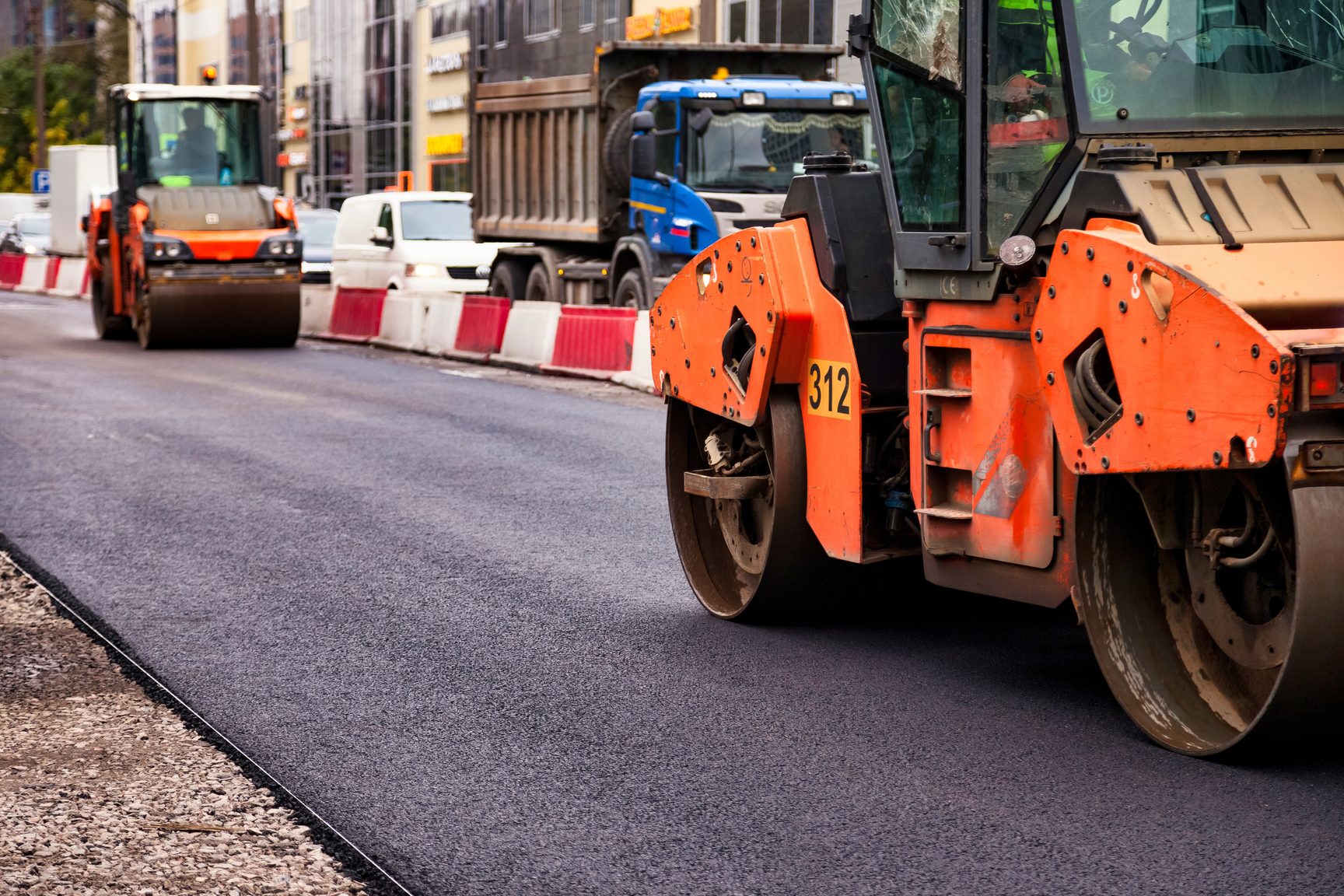
A South Carolina paving business buys general liability, contractors equipment, commercial auto and workers compensation like a paving business anywhere, and it also needs a state general contractor license before it performs or offers any job above the cost the licensing chapter sets. Beyond that license, the state reaches this trade through prequalification for firms bidding department road work as primes, bonds on larger public highway contracts, and a workers compensation law that holds a prime responsible for its subcontractors’ crews.
Those layers do not land evenly. A crew sealing apartment lots meets the license question and little else from the state; a firm bidding resurfacing as a prime meets all of it at once. Below, each layer is quoted from its South Carolina source and then read against the policies.
Asphalt paving is general construction under South Carolina’s licensing chapter
South Carolina puts asphalt paving under its general contractor license, which the South Carolina Contractor’s Licensing Board administers within the Department of Labor, Licensing and Regulation. The licensing chapter defines general construction to include asphalt or concrete paving, and among the highway classifications an Asphalt Paving subclassification reaches roads, driveways, parking lots and airport aprons and takes in sealers and slurry seals applied as part of the paving, while a Highway Incidental subclassification names pavement marking.
The license turns on the size of the job: the chapter demands it only once the total cost of construction passes a figure it sets, and each licensee is held to its license group and to the classifications it actually holds. Performing or offering general construction without the required license is unlawful, an unlicensed firm cannot sue to enforce its contract, and an owner, awarding authority or prime contractor that takes a bid from or lets work start with an unlicensed firm violates the chapter too. Because the Asphalt Paving text reaches sealers only as incidental to paving, whether a sealcoating-only job needs that subclassification is left open by the statute, and the Board’s position was not checked for this record. Contractors doing construction work for the South Carolina Department of Transportation under that department’s prequalification are exempt from the chapter.
Authority S.C. Code §§ 40-11-20(10), 40-11-30, 40-11-200(B), 40-11-270(A), 40-11-360(4), 40-11-370(A) and (C), 40-11-410(2)(c) and (e) · read the source · checked
The chapter names asphalt paving outright in its definition of general construction:
“(10) "General construction" means the installation, replacement, or repair of a building, structure, highway, sewer, grading, asphalt or concrete paving, or improvement of any kind to real property.”
The license attaches only past a cost line, and the section that draws it is the one place on this page where that figure appears:
“No entity or individual may practice as a contractor by performing or offering to perform contracting work for which the total cost of construction is greater than ten thousand dollars for general contracting or greater than ten thousand dollars for mechanical contracting without a license issued in accordance with this chapter.”
Within the highway group, the subclassification that fits most of this trade carries paving in its name and a list of surfaces that reads like an estimator’s week:
“(c) "Asphalt Paving" which includes asphalt paving, repairs and rehabilitation of streets, roads, highways, driveways, parking lots, airport runways and aprons, concrete work including curbs, gutters, and concrete or asphalt paving of storm sewers, and includes paving with sealers, geotextile fabrics, slurry seals, and surface treatments incidental thereto. This subclassification also includes work under the subclassification of Grading.”
A firm that seals lots without paving them should read the end of that text closely. Sealers, slurry seals and surface treatments come in only as incidental to paving, the chapter never uses the word sealcoat, and no subclassification is written around stand-alone sealing. The statute does not settle whether a sealing-only contract above the cost line needs this subclassification, and the Board’s view was not checked here; ask the Board before the bid. The insurance side of that business sits on the sealcoating insurance page. Striping falls under another highway subclassification, one that never says striping but does say pavement marking:
“(e) "Highway Incidental" which includes highway work for grooving, milling, rehabilitating, and installing guardrails, gutters, highway signs, pavement marking, and painting.”
The chapter also binds whoever hires the contractor: an owner or prime that considers an unlicensed bidder, or allows one onto the site, breaks the chapter as well, so a paving sub should expect its license number to be asked for beside its certificate. The carve-out that matters most to this trade is for department road work:
“(4) Contractors performing construction work for the South Carolina Department of Transportation pursuant to that department's prequalification requirements with the exception of public/private partnerships performing work pursuant to Section 57-3-200.”
That exemption follows the work done for the South Carolina Department of Transportation under its prequalification, not the firm. The same company sealing a shopping center lot the next week is back under the chapter, and the certificate that owner wants comes from the general liability program.
What South Carolina law says about coal-tar sealer
South Carolina’s Code of Laws and its Code of Regulations never mention coal-tar pavement sealant, so the state sets no prohibition, no application limit and no labeling duty for the product.
Coal tar shows up in South Carolina law only in unrelated settings, among them drug and hair-dye labeling, a water pollution prohibition and a rule against coal tar coatings inside drinking-water storage tanks. This record did not examine any city or county sealant ordinance; the ordinances of the town or county where the pavement is, whatever the lot’s owner specifies and the bid documents are where a crew confirms which sealer it may use.
Authority South Carolina Code of Laws and South Carolina Code of Regulations, both swept in full · read the source · checked
With no state text on the product, there is nothing to quote; the finding rests on a search of both codes in full. The choice of sealer is made by the lot owner’s specification, the bid package and whatever the local code says, none of which this record reviewed. What follows a sealing crew regardless is physical — mist on parked cars, sealer tracked onto a store’s entry, rinse water reaching a drain before the coat sets — and whether a spill into water reads as property damage or pollution turns on the wording the sealcoating program is built around.
Bidding SCDOT road work: prime prequalification and contract bonds
A firm has to be prequalified before it can bid as a prime contractor on South Carolina Department of Transportation construction work, and the department considers bids only from firms that have done so. Qualification rests on a sworn statement showing experience, responsibility record and available equipment, the department issues a prequalification certificate carrying an expiration date, and a renewal form keeps the status alive each year. SCDOT says a firm needs no prequalification to work as a subcontractor, and the state contractor licensing chapter exempts contractors working for SCDOT under its prequalification.
The department’s prequalification rules carry no insurance clause, but its long application will not be processed without either the firm’s workers’ compensation experience modification notice or a letter from its agent or carrier explaining why it has none and giving the policy’s effective date, and SCDOT leaves a bidder’s financial capacity to its bonding company. Bonds attach to the contract itself: state law has the department require a performance and indemnity bond and a payment bond on public highway construction contracts above a size the statute sets, and the section says nothing about smaller contracts.
Authority S.C. Code § 57-5-1650; S.C. Code Regs. 63-300, 63-301, 63-302; S.C. Code § 57-5-1660(a); S.C. Code § 40-11-360(4) · read the source · checked
The regulation that opens the prequalification rules speaks to prime bidders and nobody else:
“Persons, firms or corporations eligible to bid as a prime contractor on construction work for the Department of Transportation shall have prequalified as herein required. No bids for such work will be considered by the Department of Transportation except from persons, firms or corporations that have so prequalified.”
The department’s page states the other half plainly, which is what a striping or paving firm that reaches public work through a prime needs to know:
“Prequalification is not necessary to do subcontract work.”
A sub is not wholly outside the system: a firm the department has disqualified or found in default can be kept off new projects as a subcontractor as well. For a prime, status is kept up rather than earned once:
“Fill out the Short Form annually to keep prequalification status.”
The experience table in the long application sorts past work into categories, and several describe this trade as printed:
Since equipment is part of what prequalification is shown on, the list sent to the department and the schedule on a contractors equipment floater should match.
The workers compensation paper the application asks for
None of the prequalification regulations mentions insurance, bonds or sureties. The demand comes from the long application form, and it concerns workers compensation alone — a current experience modification notice or, for a firm without a rating, this:
“If the Company does not qualify for an EMR, attach a copy of a letter from the Company's Workers Compensation Insurance Agent or Carrier stating the reason why the Company does not qualify for an EMR. The letter must include the Effective Date of the Workers Compensation Policy.”
Without one or the other the file is not processed, so a new firm needs its agent’s letter in hand before it applies; how a modification is built from a firm’s own losses is covered on the workers compensation coverage page. No liability insurance requirement appears in the regulations, on the page or in the form, which leaves each contract to set its own.
Contract bonds and the bonding company’s role
The department does not measure a bidder’s finances itself, and its form tells applicants not to send statements:
“The SCDOT relies upon the bidder's bonding company to determine the bidder's financial capacity to accomplish the work being bid.”
The bonds come from statute. On public highway construction contracts above a size the section sets, the department must require a performance and indemnity bond and a payment bond; the section is silent about smaller contracts. A bond is a surety’s guarantee to the owner, not insurance, and it is written on the firm’s finances, so capacity is best settled before a letting season rather than during one.
Workers compensation in South Carolina: an open market and a prime’s duty to subs
An employer under South Carolina’s workers’ compensation law must either carry what it owes through an authorized insurer or through an employers’ mutual association authorized for the purpose, or show the South Carolina Workers’ Compensation Commission it has the financial means to pay benefits on its own, which the Commission may allow similar businesses to do as a pooled group of self-insurers. The law presumes every employer and employee has accepted it, and it leaves out employers smaller than the size it prints. Private employers buy the coverage from licensed insurers or the assigned risk program, or self-insure; the State Accident Fund, a state agency, covers the State and the local governments that elect it.
Subletting does not shift the duty away from the prime. A contractor that hires a subcontractor for part of its work owes compensation to that subcontractor’s workers as though it employed them itself, which is why the Commission notes that general contractors often require subcontractors to carry their own coverage.
Authority S.C. Code §§ 42-1-310, 42-1-360(2), 42-1-410, 42-5-20(A)(1), 42-7-10(A), 42-7-50 · read the source · checked
The Commission sets out where an employer actually finds the coverage:
“Workers’ compensation insurance coverage can be obtained via a commercial insurance carrier licensed to write workers’ compensation insurance coverage in the state of South Carolina or via the state’s assigned risk program, which is administered by the National Council on Compensation Insurance (NCCI). An employer may also apply to become self-insured or participate in a self-insurance fund.”
That makes South Carolina a competitive state for a private paving business. The state does run a fund, but it is not one a contractor can buy from, and its own description says whom it serves:
“Since 1943, the South Carolina State Accident Fund has provided workers' compensation coverage for the state of South Carolina and local governmental entities within South Carolina.”
The rule with the widest reach for a paving company is the one on subletting, stated in the finding above: an uninsured striping or sealing sub on your job can become a claim on your policy. The Commission explains why primes ask for proof:
“A general contractor may require their subcontractors to maintain workers’ compensation insurance to work on their jobs in order to avoid the liability of a workers’ compensation claim from an uninsured employer/subcontractor.”
Its FAQ pages do not word the general-contractor answer identically, so this page leans on the statute for the rule. How subcontractors are handled when a policy is written is set out on the workers compensation page, and the South Carolina Department of Insurance licenses the insurers and agencies behind every line in the program.
The South Carolina agencies behind each requirement
Each body holds a different piece, and none speaks for the others:
Paving markets and the SCDOT districts they fall in
The department groups counties into engineering districts and lists them on a single contacts page. Each market below carries a county the Census places it in and that county’s district; each sits in a different district, and no size or population figure is attached.
Columbia
Richland County. District 1.
The Census file also places the city in Lexington County, which the department puts in the same district, so a job across that county line answers to one district office.
Charleston
Charleston County. District 6.
The city reaches into Berkeley County on the Census list too, in the same district. A lot manager, the city and the department each write their own insurance article.
Greenville
Greenville County. District 3.
No other market here shares its district. A firm based here bidding department work elsewhere deals with another district office, on the same prequalification certificate.
Rock Hill
York County. District 4.
Its county sits in a district of its own among these markets. The certificate a private lot owner wants is rarely worded like the one a public owner wants.
Myrtle Beach
Horry County. District 5.
Horry County lies in a district none of the other markets falls in. Moving pavers and rollers between districts is the exposure the auto and equipment lines follow.
Aiken
Aiken County. District 7.
The county falls in a district apart from every other market listed. For a sub, the prime’s contract matters more than the district, since a sub needs no prequalification.
Pricing factors for a South Carolina paving program
What moves the price of a paving program — the mix of paving, sealcoating and striping work, the payroll and loss history behind it, and how workers compensation is bought — is set out in our national guide to what paving contractor insurance cost depends on. This page keeps to South Carolina’s rules, agencies and markets.
Loss patterns on South Carolina paving jobs
Fresh sealer and a moved cone. A driver ignores a closure and rolls onto an uncured coat. Damage to that vehicle is someone else’s property, while the ruined section of your work is a separate question, and the general liability page shows where that line falls.
Pedestrians on a lot left open. An owner who keeps a store or apartment lot running during work puts people on wet paint and soft edges, and the owner’s contract has often shifted that risk to you already.
Traffic beside a department work zone. A claim there pulls in the traffic control setup, the owner and every contractor on the job, and the contract’s limits matter more than any floor.
An injury on your crew, or a sub’s. A burn at the screed, a worker struck by a reversing roller. Under the subletting rule, the sub’s half of that heading can land on a prime whose sub carried nothing.
South Carolina: Contractor license, a state license or registration can reach this work, connected to the General Liability page. Coal-tar sealant, no state rule on the product, connected to the Asphalt Sealcoating Insurance page. Transportation department prequalification, applies to department road work, connected to the Commercial Auto page. Workers’ compensation, bought in the open market, connected to the Workers Compensation page. The diagram pairs each state rule with the page on this site that discusses it and shows no figures.
Nearby states we also write
South Carolina’s neighbors are North Carolina and Georgia, both inside the licensed footprint. Nothing verified here carries across either line, so a crew working over it should read each state’s own findings before assuming its license, road-work or workers compensation rules match.
Related coverage and services
What we insure
Coverage lines
South Carolina paving contractor insurance questions
Is a state license required to pave in South Carolina?
Above a job-cost trigger in the licensing chapter, yes. The chapter counts asphalt paving as general construction, and its highway group carries an Asphalt Paving subclassification. The South Carolina Contractor’s Licensing Board issues the license, and a firm may only take work within the group and classifications it holds. The duty runs both ways: an owner or prime that lets an unlicensed firm start work above the trigger breaks the chapter too.
Does a sealcoating-only company need the Asphalt Paving subclassification?
That is an open question. The subclassification mentions sealers and slurry seals only as part of a paving job, the chapter has no separate category for stand-alone sealcoating, and the Board’s view was not checked for this page. A firm that only seals lots should put the question to the South Carolina Contractor’s Licensing Board in writing before it bids work above the trigger.
Can I use coal-tar sealer on a South Carolina parking lot?
The state itself does not stop you. Neither the Code of Laws nor the Code of Regulations speaks to coal-tar pavement sealant, so no state ban, limit or label duty exists. No city or county ordinance was reviewed for this page, though, so the local code where the lot sits, the owner’s specification and the bid package are what decide which sealer goes down on a given job.
Do I need SCDOT prequalification to work as a subcontractor?
No. The South Carolina Department of Transportation prequalifies firms that bid its construction work as prime contractors, and it says in its own words that subcontract work needs none. A firm the department has disqualified, or one that defaulted, can be barred from subcontracting on new projects, so a sub’s record with the department still matters even though it never applies.
What does SCDOT ask about workers compensation when I apply?
The prequalification rules themselves say nothing about insurance. The long application form does: it wants the firm’s latest experience modification notice, or, if the firm has no rating yet, a letter from its agent or carrier saying why and giving the policy’s effective date. The application will not be processed without one of those, and it also asks which surety the firm used last.
Can a private paving company get coverage from the State Accident Fund?
No. That fund is a state agency, and it insures the State and the counties, cities and other local public bodies that choose to join it. A privately owned paving business buys workers compensation from a licensed insurer or through the assigned risk program, or qualifies with the South Carolina Workers’ Compensation Commission to self-insure, alone or in a group.
If my subcontractor has no workers compensation, am I responsible?
Under the statute, a contractor that sublets part of its work owes compensation to the subcontractor’s injured workers as if it had hired them directly. That is why primes collect certificates before a sub’s crew starts, and why an uninsured sub can show up as a claim on the prime’s own workers compensation policy. A certificate checked before the job starts does far more good than one requested after someone is hurt.
This page describes insurance for paving and asphalt contractors operating in this state. It is general information, not legal advice and not a statement of coverage. Licensing, permitting and environmental requirements change; verify current requirements with the agency named before relying on them.
Get a quote for your South Carolina paving work
Tell us which license classifications you hold, whether you bid SCDOT work as a prime or a sub, and who you hire, and we will build the South Carolina program around it.