
Services we insure
Paving Contractor Insurance
Every policy an asphalt operation runs on, in one place — and a straight answer about which of them picks up the loss in front of you.
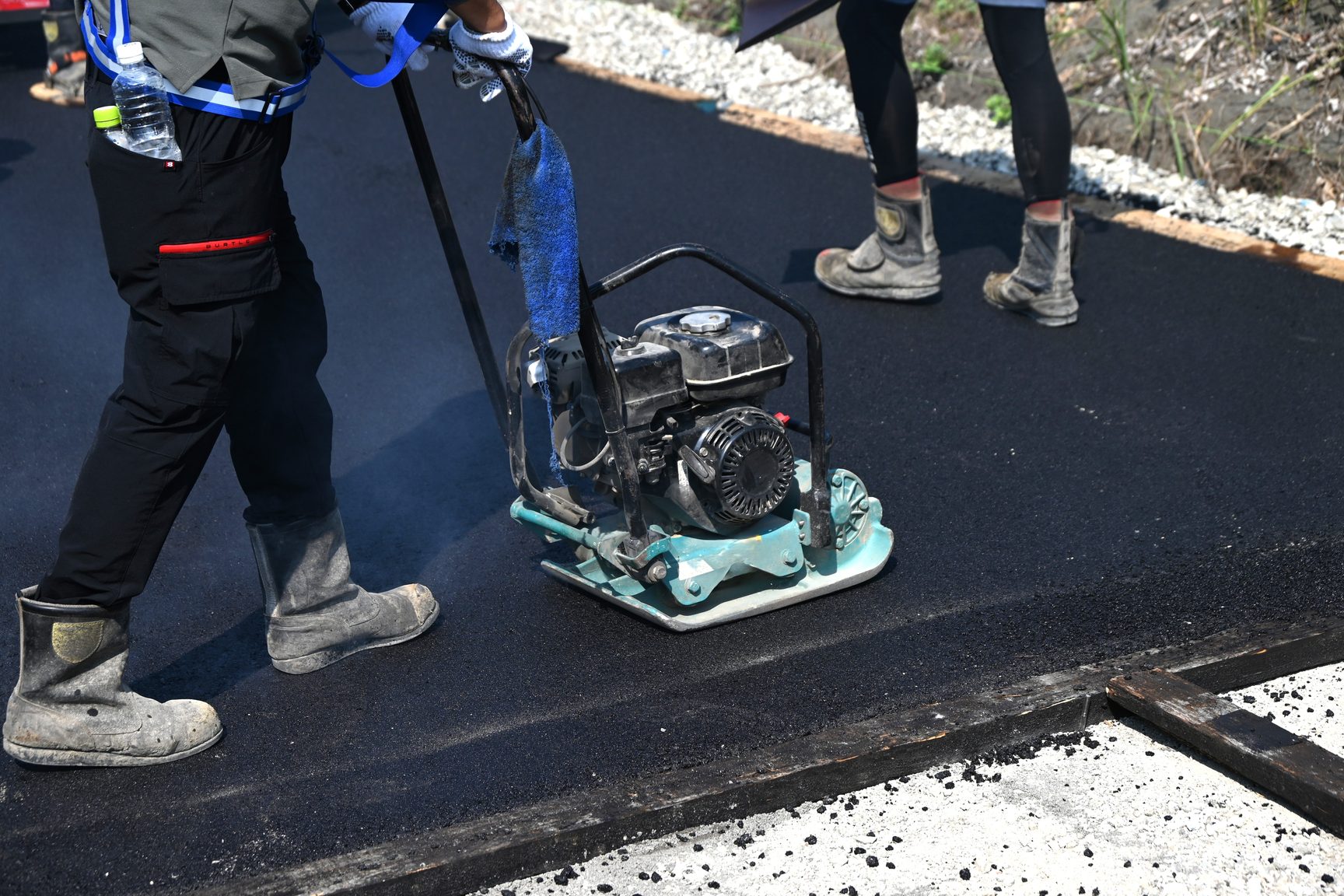
Paving contractor insurance is not a single policy but a program of them, covering an asphalt operation end to end: the liability you carry onto property somebody else owns, the machines you own, the trucks that haul them, the payroll that runs them, the yard they return to, and the specification decisions you are paid to get right. Because no one policy does all of that, asphalt paving insurance is assembled rather than bought off a shelf — and the question worth asking is rarely whether you are covered, but which of these policies answers the loss sitting in front of you.
This page is the map. Paving, sealcoating, crack sealing, milling, resurfacing and striping are a single trade commercially and several different risks on paper, so a contractor who does all of them is buying against a wider spread than the word paving suggests. Hot mix goes down at working temperature. Pavers, rollers and milling machines travel between jobs on a trailer pulled by a registered truck. A crew works in the right-of-way behind traffic control and a flagger while the public keeps driving through. And the finished surface is the product, judged long after the invoice has cleared.
The defining feature of the class is that almost none of the work happens on ground you control. A retail lot, a campus drive, an apartment complex, a municipal street — each belongs to somebody else, and each is occupied while you are working on it. That is why this trade produces claims against other people and their property far more reliably than it produces claims on its own yard, and why the lines below have to be read against each other rather than examined one at a time.
So the rest of this page does what a program review does. It sets out what a policy written off a generic contractor class tends to miss on an asphalt account, why the place you are working changes part of the answer, and then walks each line of the program and hands you to the page that answers it in full. If you already know which question you have, skip ahead to it.
Where a generic contractor policy stops describing this trade
A commercial package written for a building contractor assumes a jobsite with a fence around it, a schedule of trades working under a superintendent, and a structure at the end of it. An asphalt operation has none of those. The site changes every week, the public is inside it the whole time, the product is a surface rather than a building, and the most valuable things on the job drive themselves. Several consequences follow, and together they are the reason a program built for this trade looks different from a package pulled off a class code.
The same machine is read differently by different policies. A roller is equipment while it is compacting, cargo while it is riding a trailer, and something else again the day somebody registers it for the road. Which policy answers depends on what the unit was doing and how it is titled, and the wording that decides it is already sitting in policies you hold. That boundary is worked from the forms themselves on the general liability page, and there is no shortcut version of it worth printing here.
The product is a surface, and it is judged after you leave. A building contractor hands over something that gets inspected before anybody uses it. You hand over a lot that gets driven on immediately and complained about in the second season. The day the lot opens to traffic matters far more on this trade than the day you invoiced, and a policy that does not account for that difference will surprise you at the wrong moment.
You spend your year insuring other people. Certificates and additional insured status get demanded of this trade more often than of almost any other, and the reason is simply whose ground you are standing on: a general contractor this week, a retail landlord next week, a property manager and a municipality the month after. Those demands are not interchangeable and they are not satisfied by the same piece of paper, which is a detail that costs contractors real money when it surfaces during a claim instead of before a bid.
You subcontract, and you are subcontracted to. Striping goes out, hauling comes in, a milling crew arrives for a week. Every one of those relationships brings somebody else’s operations inside your project and, eventually, inside somebody’s claim file. The controls that matter here are unglamorous — who you collect from, what you collect, and whether anybody reads it.
Nothing stands still, but something still stands. The yard, the shop, the sealer and aggregate stored behind the fence, the sign at the road. A program assembled entirely around mobility tends to treat the fixed half of the operation as an afterthought, and that is the half that burns, floods or gets cut open overnight.
Where the work happens, and why that is a coverage question
What a public owner will accept as evidence of coverage, how payroll is reported, which registrations a contractor needs before crossing a line to take a job — none of that is the same everywhere, and a paving contractor usually discovers the differences on the job rather than in the office. This site is not going to tell you what your own state expects of you. A page that generalizes about states is a page that is wrong somewhere, and being wrong about that in an insurance context is expensive. What a national page can usefully do is name the questions that change at the line.
Public work is the sharpest version of it. Paving under contract to a public body is a different commercial animal from resurfacing a private lot: the contract is administered rather than negotiated, the insurance article was written by somebody who is not going to amend it for you, and the evidence requirements arrive bound into the bid documents instead of as a polite request afterward. Prequalification is a separate hurdle again, and it tends to ask about the same things an underwriter asks about — experience, equipment, and whether anybody got hurt.
Work-zone practice on the very same job answers to another authority entirely, one interested in how the lane closure was built and how the flagger was positioned rather than in who insured the crew. It is not a coverage question until a claim makes it one, at which point what you did on the ground becomes the first thing anybody asks about. The federal work-zone and construction-safety material linked at the foot of this page is where that side of it is described by the people who own it.
Our licensing is published on this site, and state-level detail is being built out page by page at the states we serve. Until yours is there, the quickest route is to tell us where the trucks actually go and let a licensed agent answer it directly rather than by inference.
The program, line by line, and where each question is answered
These are the policies a paving, sealcoating and striping business actually runs on. Each has a page of its own that works the wording rather than summarizing it, so what follows is the reason to click rather than the content behind the click.
- General Liability — what your work does to other people and their property: the drift that reached the next row, the open edge somebody walked into, the building at the perimeter. Read it for the property exclusions, which decide whether a claim belongs on this policy at all.
- Contractors Equipment — the inland marine cover that pays for damage to your own pavers, rollers, tanks and rigs, owned, rented in and in transit. Read it if the schedule has not been opened since the last machine arrived.
- Commercial Auto — dump trucks, tack trucks, lowboys and the trailers behind them, on the road and at the jobsite. Read it if a unit has changed its plates, or if you have started renting trucks to get through the busy stretch.
- Workers Compensation — for the person who was hurt and draws a check from you, as opposed to the one who was merely walking past. Read it before the seasonal crew starts rather than after, because how you describe that payroll is what the whole line rests on.
- Professional Liability — grade, drainage, mix selection and layout: the decisions you get paid to make rather than to execute. Read it if anybody has ever asked you to recommend a solution rather than to price a drawing.
- Property — the yard, the shop, stored sealer and aggregate, the fence and the sign. Read it if you own the yard, or if your lease quietly says you are the one insuring it.
Parts of the work carry pages of their own, because they behave differently enough to deserve them. Asphalt Sealcoating Insurance follows the drift exposure end to end — product that goes down wet, travels on the breeze and settles wherever it settles, applied a lane away from parked cars and storefront glass by a crew handling hot material all day. Parking Lot Striping Insurance covers the half of this trade that happens in a lot the public has not been cleared out of, where the layout itself is a professional decision before it is a paint job.
What decides the price of an asphalt program
What decides the price of an asphalt program — the mix of paving, sealcoating and striping work, who the customer is, the payroll and the equipment schedule, where the trucks go, and the loss history — is set out driver by driver in our guide to what paving contractor insurance cost depends on. This page keeps to the program itself; the guide keeps to what an underwriter reads.
Loss scenarios, and which policy picks them up
Categories rather than case studies, and without figures attached — a claim example carrying a number is a fabricated number wearing a story. What is useful about each of these is not the size of it but where it lands.
Something you applied ended up somewhere it was not wanted
Sealer, tack, paint or thermoplastic reaching cars, storefront glass, a facade, signage or the planting beds around the edge of a lot. No other claim against somebody else’s property arrives on this trade as predictably. It is usually modest in size and frequent in occurrence, and frequency is exactly what a market prices. The treated surface itself lands somewhere quite different from the car parked beside it, which is worked through on the liability page.
Somebody was hurt in a place you were working
A pedestrian crossing a lot under treatment, a driver entering a partially closed lane, a tenant walking past an open edge — and, out of the identical incident, a member of your own crew. Those are not the same claim and they do not go to the same policy, and this trade produces both out of a single incident more often than most. Severity here can be serious in a way the drift claims never are.
A machine stopped being worth what it was
Fire on a paver, a roller damaged coming off a trailer, a skid steer taken out of the yard overnight, a tank damaged being recovered from soft ground. The loss is to your own property, so it is answered by the equipment side of the program rather than the liability side — and how much it pays depends on a valuation basis chosen long before the loss.
The lot came back
Ravelling, ponding, failed joints, a surface that did not hold through its first hard season, a layout an owner says was wrong. These arrive after the job closed, they arrive as a demand rather than as an incident, and they routinely straddle the line between redoing your own work and damaging somebody else’s property. They are also the category most likely to involve the professional side of the program.
What an underwriter reads before quoting a paving account
The specialty markets that write this class have seen a great many asphalt operations, and they are not reading your submission for surprises. They are reading it to work out which of the operations they already know about yours resembles. The account that gets a straight answer quickly is the one that describes itself precisely enough to be placed.
The equipment schedule is usually opened first, because it says more about an operation than any narrative does. Units, model years, values and how those values were arrived at tell a reader the size of the business, whether it is growing, and whether anybody is maintaining the list. A schedule with gaps in it invites questions about everything else.
Payroll comes next, described by what people actually do rather than by job title, and split honestly between operations. Then the work mix and the customer mix, because a market’s appetite is expressed in those terms. Then the loss record, and what shape it has. Then the practical controls: how traffic control is set up, how the crew is trained for it, what happens to equipment overnight, and what you collect from a subcontractor before letting them on your job.
Contract requirements are the last input and the one contractors supply least often, which is a missed opportunity. A market can build a program to a known requirement far more comfortably than it can guess at one, and a sample of the insurance article you are actually being asked to sign is worth more to a submission than a page of description.
Why we write the whole program rather than a line of it
Most of the arguments a paving contractor ends up having with an insurer are seam arguments. The loss is real, the policies are in force, and the disagreement is about which one owns the file. A program bought a line at a time from whoever quoted cheapest on each has more of those seams than a program assembled deliberately — and nobody involved in it is looking across them, because no one of them was hired to.
That is the work here. We put the whole program in front of specialty markets that are actively writing asphalt work, and then we read the resulting policies against one another and report back on the places they touch and the places nothing is standing. Everything on this site describes wording in general use, and general use is only ever the starting point; what decides your claim is the endorsement schedule attached to your own policy, which is why we ask to see it.
There is a person at the end of every submission that comes through here. What you pave, where you pave it, who hires you, what you own and what has already gone wrong are the inputs, and what comes back is written in plain English with every seam identified by name — not a bare figure with no reasoning standing behind it.
This page describes how a paving program is usually assembled and what each line is generally for. Wording differs from carrier to carrier and from edition to edition; the policy sitting in your own file is the one that governs your claim. Treat what is written here as orientation rather than as advice on your account, and read the policy itself before relying on any of it.
Related coverage and services
Coverage lines
- General Liability — third-party injury and property damage from your work.
- Contractors Equipment — the floater for your own pavers, rollers and tanks.
- Commercial Auto — registered trucks and trailers, on the road and on the job.
- Workers Compensation — the line for injuries to your own crew.
- Professional Liability — grade, drainage, mix and layout decisions.
- Property — the yard, the shop and what is stored behind the fence.
What we insure
- Asphalt Sealcoating Insurance — the drift exposure, end to end.
- Parking Lot Striping Insurance — layout, traffic and live lots.
Outside authorities
Read next
- Bid, Performance and Payment Bonds for Paving Contractors
- Joint Venture Paving Bids and Who the Policy Names
- Reading an Asphalt Paving Contract Before You Sign It
- How to Build an Asphalt Paving Estimate Line by Line
- Writing a Paving Business Plan That Accounts for Risk
- Working Capital for a Paving Company’s Short Season
- Building a Work Zone Safety Plan for a Paving Crew
- New York Asphalt and Paving Contractor Insurance: What You Need Before Bidding Public Work
- Paving Contractors Insurance in Massachusetts: Coverage, Requirements, and Where to Buy
- What Insurance Do Paving Contractors Need for City and County Jobs?
- Insurance Requirements for State DOT Paving Work: What Asphalt Contractors Must Carry
What gets asked on the first call
I only pave driveways for homeowners. Do I need the same program a commercial contractor needs?
The list of lines is the same; the weight on each one is not. You still carry liability onto property you do not own, you still own machines that get damaged and taken, you still haul them behind a registered truck, and if somebody is on your payroll that line applies to you exactly as it applies to a highway contractor. What changes on residential work is emphasis. Nobody is handing you a specification to interpret, so the professional exposure is thinner. Nobody is demanding additional insured status on a schedule, so the endorsement load is lighter. The yard is usually smaller and the radius shorter. That is a conversation about proportions rather than a shorter shopping list, and it is worth having before somebody sells you the commercial version of everything.
We only sealcoat and stripe. No hot mix. Is this page still for us?
Yes, and the two pages linked above are written for precisely that operation. Sealcoating and striping carry the same core program as paving — liability, equipment, trucks, payroll, yard — but the loss that actually arrives is different in shape. A sealcoat crew is working with a liquid a lane away from parked cars and storefront glass, so drift is the signature exposure rather than an occasional one. A striping crew is laying out a lot the public is still driving through, and the layout itself is a decision somebody may later say was wrong. Those are the pages that work each of those through. This one is the map above them.
The same machine keeps coming up on two different policies. Which one is it on?
Both, for different reasons, and the reason is what decides which one answers a given loss. Whether a unit is read as equipment or as a registered vehicle, and whether the question is what it did to somebody else or what happened to it, are the two axes that place it. That boundary is worked from the form itself on the general liability page, with the equipment page and the auto page picking it up from their own sides. It is the single most useful thing on this site to read before a renewal rather than after a loss, because the answer is already written into policies you are holding.
We sub out our striping and we get subbed to general contractors. Does that change the program?
It changes what you have to collect and what you are asked to give, in both directions at once. When you hire a sub, their coverage becomes part of your exposure whether or not you looked at it, and the certificate in the folder is evidence rather than protection. When a general contractor hires you, the insurance article in that contract is where your own endorsement requirements are actually set, and it is usually not negotiable by the time it reaches you. Whether work performed by a sub is treated differently under your own policy is a question the general liability page answers from the form rather than from custom.
How much of this is required, and how much is our own choice?
Far more of it is decided by the agreements you sign than most contractors expect. Public owners and general contractors write insurance articles that name the lines, the structure and the status they want, and a bid that does not meet them is not a cheaper bid, it is a rejected one. What an employer owes its own people is a separate question that depends on where the work happens, and a national page has no business generalizing about it. Between those two sits genuine discretion: how much equipment you schedule, how you value it, whether you carry the professional line at all. That is the part worth spending an actual conversation on.
Can one agency place all of it, or do these lines have to be split up?
All of it can sit with one agency, and on this class there are practical reasons to want that. The seams between these policies are where paving disputes live, and nobody reads across a seam if each side belongs to a different agent. A single relationship also means the exposure gets reported once instead of described differently to different markets, which is how a schedule ends up disagreeing with itself. Splitting does happen, usually because one line got placed somewhere specialized and stayed there. It is workable. It just means somebody has to own the job of reading the whole program, and that somebody should be named.
We already have coverage somewhere else. Is it worth having it looked at?
The useful version of that review is not a price comparison. Send the declarations pages and the endorsement schedules for every line you carry, and what comes back is a map of what is actually on them: which units are scheduled and at what basis, which parties have status and under which endorsement, where the liability policy and the auto policy meet, and what is sitting in a gap nobody has looked at since the account was written. That review is worth having whether or not anything moves. Plenty of accounts stay exactly where they are and simply stop carrying a hole in the middle of them.
Put the whole program in front of one agent
Send whatever you have — declarations pages, an equipment list, a payroll summary, or simply an account of the work you take on and the ground you take it on. A licensed agent reads it, says which policy answers which loss, and points out any gap worth closing.