
Paving Contractor Insurance by State
Maryland Paving Contractor Insurance
Maryland bars high-PAH sealer from driveways and parking areas, licenses residential driveway work only, and weighs public-road bidders contract by contract.
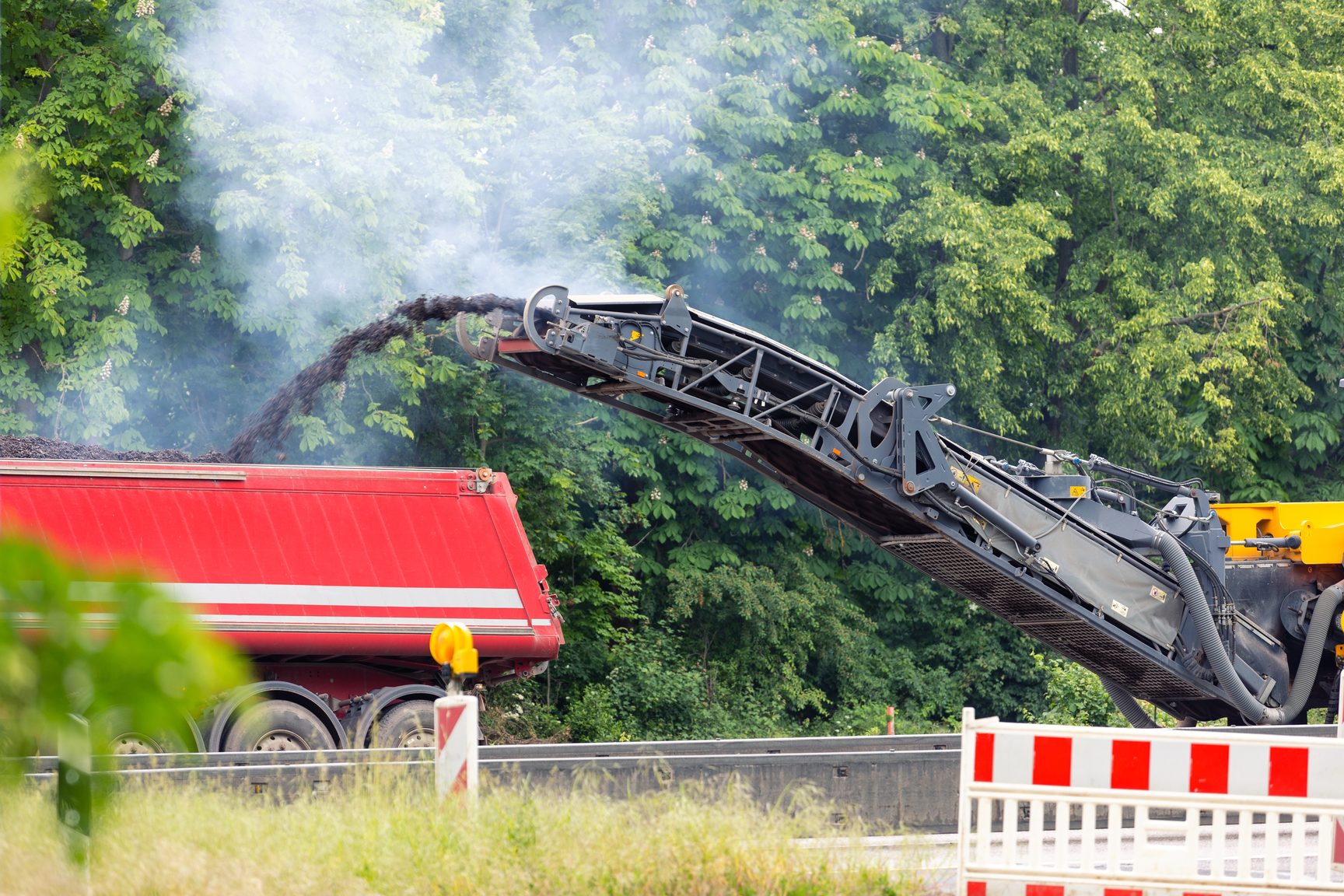
A Maryland paving, sealcoating or striping business carries the core policies it would carry in any state: general liability, a contractors equipment floater, commercial auto, property coverage and the workers compensation the law requires for employees. What Maryland adds is a sealant law aimed at the material in the tank, a residential license that follows the homeowner’s driveway, and public-road bidding that screens each bid instead of keeping a prequalified list.
Those rules land on different customers. A homeowner’s driveway brings the license and its liability condition; a shopping center lot brings only the owner’s contract and whatever the county asks; a state highway job brings a responsibility finding, bonds and a certificate naming the state. Each section below quotes the governing text and then turns it into what it means for the paving contractor program.
High-PAH sealer is off Maryland driveways and parking areas
Maryland bars high-PAH pavement sealer from driveways and parking areas in both directions: since the date its Environment Article sets, no one may supply, sell or offer it for sale for use on a driveway or parking area in the state, and no one may apply it or solicit its application there. The law defines the product by chemistry, as a sealant containing more polycyclic aromatic hydrocarbons by weight than the percentage it prints, rather than by the words coal tar. It is a sale and use prohibition, not a labeling rule, and the Maryland Department of the Environment holds the rulemaking power.
The prohibition leaves out airports, federal facilities and military facilities, and counties, municipalities and other local governments may adopt stricter sealant rules but never looser ones. Each violation carries civil and administrative penalties, and each day counts as a separate violation. Because the test is the product’s PAH content, a sealcoating crew working a Maryland driveway or lot has to know that figure for the material it puts down; roads outside a driveway or parking area are not named by the section.
Authority Md. Code, Env. §§ 9-2401 through 9-2405; Env. § 1-101(d) · read the source · checked
The core prohibition is written against the seller and the applicator alike, and it names the surfaces it covers:
“On or after October 1, 2023, a person may not: (1) Supply, sell, or offer for sale a high–PAH sealant product for application to a driveway or parking area in the State; or (2) Apply or solicit the application of a high–PAH sealant product to a driveway or parking area in the State.”
Which products fall inside it is a question of chemistry. The definition sets a threshold for polycyclic aromatic hydrocarbons by weight and says nothing about the brand, the label or the base material:
“In this subtitle, “high–PAH sealant product” means a sealant product containing more than 1.0% polycyclic aromatic hydrocarbons by weight.”
That puts the product data sheet at the center of every Maryland sealcoating job. Ask the supplier for the PAH content in writing, keep it with the job file, and treat a drum whose content nobody can document as a drum that stays on the trailer. Because the statute never uses the words coal tar, a label that avoids them settles nothing; the content does. The carve-outs name places, not products:
“(b) This subtitle does not apply to: (1) Airports; (2) Federal facilities; or (3) Military facilities.”
Outside those facilities, a driveway or a lot anywhere in the state is inside the rule, and a county or town may go further than the state, so a crew moving between jurisdictions reads the local code too. Enforcement is counted per violation and per day:
“(c) (1) A person who violates this subtitle is subject to: (i) A civil penalty up to $2,500 for each violation; and (ii) An administrative penalty up to $2,500 for each violation, but not exceeding $100,000 total. (2) Each day a violation occurs is a separate violation under this section.”
Penalties are the state’s remedy, not a customer’s claim. What a policy would answer when an owner demands that the wrong material come off a lot turns on the wording of the general liability policy, so settle it before the season. For the sealcoating program, the law changes what goes in the tank but not the everyday exposures: mist drifting onto a parked car, sealer walked into a lobby, rinse water heading for a storm drain before the coat sets.
The home improvement license follows the driveway, not the trade
Maryland licenses residential paving through the Maryland Home Improvement Commission. Anyone acting as a contractor for home improvement work in the state needs the Commission’s contractor license, and the statute’s definition of home improvement expressly takes in building or replacing a driveway on the land next to a home. The license follows the residence rather than the trade: it covers work on a building used as a dwelling and the land beside it, and it stops at apartment buildings of the size the statute names and at the common areas of condominiums.
The residential license brings its own conditions. An applicant must prove it carries general liability coverage at a statutory floor, that coverage has to stay in force for as long as the license is held, and acting as a contractor without the license is a misdemeanor. Commercial lots and public roads sit outside a definition built around residences, and none of the trades the Department of Labor’s licensing division regulates is a general, paving, sealcoating or striping contractor license, so commercial work answers to the owner, the contract and any local rule rather than to a state trade license.
Authority Md. Code, Bus. Reg. §§ 8-101(g), 8-301(a), 8-302.1, 8-303(a)(2), 8-601 · read the source · checked
The definition is built around the home, and then it lists the work on the land beside it that counts. A driveway is named outright:
“includes: (i) construction, improvement, or replacement, on land adjacent to the building, of a driveway, fall–out shelter, fence, garage, landscaping, deck, pier, porch, or swimming pool;”
The same definition then sets aside work that looks residential but is not treated that way:
“(v) work done on apartment buildings that contain four or more single–family units; or (vi) work done on the commonly owned areas of condominiums.”
That divides a paving firm’s customer list. Replacing a homeowner’s driveway is licensed work; the lot at a larger apartment complex, a condominium association’s shared drive and a county road are not. The license also writes an insurance condition into the statute itself:
“(a) An applicant for a contractor license shall maintain general liability insurance in the amount of at least $500,000. (b) A licensed contractor shall maintain general liability insurance in the amount of at least $500,000.”
That condition runs from the application through the life of the license, so a lapse in the liability program becomes a licensing problem as well as an insurance one, and working unlicensed is a criminal matter rather than a paperwork slip. On commercial lots the requirements come from the owner’s contract and any local permit instead.
SHA keeps no prequalified list, so each bid is weighed on its own
The Maryland Department of Transportation State Highway Administration does not prequalify the firms that bid on its construction work, and the state’s procurement regulation that once provided for prequalifying bidders now stands repealed. SHA tells a firm that wants its work to register in eMaryland Marketplace Advantage and read each solicitation, and award is made to the low bidder whose bid is responsive and whom the procurement officer finds responsible for that job.
The screening happens bid by bid instead. State procurement law makes a procurement officer reject a bid from a bidder found not responsible, SHA’s specifications require a proposal guaranty with bids on larger contracts and performance and payment bonds before a larger contract is executed, and on SHA’s own contracts the winning contractor must hand the procurement officer a certificate of liability insurance, with the State of Maryland added as an insured, before the contract is signed.
Authority COMAR 21.05.02.05; Md. Code, State Fin. & Proc. § 13-206(a); SHA Standard Specifications GP-2.07, GP-2.19, GP-3.03, GP-7.14, TC-5.01 · read the source · checked
The regulation that once set up prequalification now survives only as a heading:
“Prequalification of Bidders — Repealed.”
The screen that replaces a list sits in the procurement statute, and it binds the procurement officer rather than leaving the point to discretion:
“A procurement officer shall reject a bid or proposal if the procurement officer determines that: (i) the bid is nonresponsive or the proposal is unacceptable; or (ii) the bidder or offeror is not responsible.”
Because that finding is made for each contract, nothing carries a firm from one letting to the next. When a bidder shows capability, the equipment list it hands over should match the schedule on its contractors equipment floater, so an owner comparing them finds the same machines on each.
Guaranty, bonds and the certificate before signing
Security attaches at bid on the larger contracts, as the specifications print it, and the performance and payment bonds follow before execution:
“No bid will be considered for any Contract in excess of $100,000 unless accompanied by a guaranty in an amount not less than 5 percent of the amount bid, or such amount as may be specified elsewhere in the bid documents and made payable to the State of Maryland.”
A bid guaranty and a performance bond are surety, not insurance. The surety answers to the owner and then looks to the contractor, and it underwrites the balance sheet rather than the loss history, so that capacity is built before the letting season. The insurance itself is a contract term, and the specifications write the state into the policy:
“The State of Maryland shall be listed as an additional insured on the policy. The limit of liability shall be no less than $1 000 000 per occurrence/$2 000 000 general aggregate.”
On SHA’s own contracts the certificate carrying that wording has to reach the procurement officer before the contract is signed, so the endorsement belongs in bid preparation, not the mobilization checklist.
Workers compensation: required for every covered employee, bought in an open market
Maryland makes every employer secure workers’ compensation for all of its covered employees, and the Labor and Employment Article lists the ways to do it: insurance with an authorized insurer, a governmental or private-employer self-insurance group that meets the law’s requirements, individual self-insurance, or, for county boards of education and private noncollegiate institutions, the route the Education Article provides. The Maryland Insurance Administration licenses the insurers, and the market is competitive. One of them is a private, nonprofit insurer the legislature created, which must serve as the workers’ compensation insurer of last resort and may refuse, cancel or decline to renew a policy only for the reasons the statute lists; no employer is obliged to place its coverage there.
Going without coverage is enforced through the Maryland Workers’ Compensation Commission. When an employer has not secured compensation, the Commission orders it to a show-cause hearing and, on a finding against it, orders it to insure with an authorized insurer, prove the coverage and pay a penalty to the Uninsured Employers’ Fund, with a further penalty available if it ignores that order.
Authority Md. Code, Lab. & Empl. §§ 9-402(a), 9-407; Md. Code, Ins. §§ 24-303(b), 24-304, 24-306(a) and (c) · read the source · checked
The statute lists the routes an employer may use to meet the duty:
“(a) Subject to subsections (b) through (f) of this section, each employer shall secure compensation for all covered employees of the employer by: (1) maintaining insurance with an authorized insurer; (2) participating in a governmental self–insurance group that meets the requirements of § 9–404 of this subtitle; (3) participating in a self–insurance group of private employers that meets the requirements of Title 25, Subtitle 3 of the Insurance Article; (4) maintaining self–insurance for an individual employer in accordance with § 9–405 of this subtitle; or (5) having a county board of education or private noncollegiate institution secure compensation under § 8–402(c) or § 7–114(d) of the Education Article.”
The governmental group and the education route are not open to a private paving firm, which leaves an authorized insurer, a private employers’ group or self-insuring alone. Among the authorized insurers, the statute-created company carries a duty the others do not:
“(a) The Company: (1) shall be an authorized insurer; and (2) on and after October 1, 2013, as a condition of being an authorized insurer, shall be the workers’ compensation insurer of last resort for employers covered under Title 9 of the Labor and Employment Article.”
It is a fallback, not a requirement, so it belongs in the comparison at renewal like any other authorized insurer. How payroll is divided between paving, sealcoating and striping, and how an owner who runs a roller is treated, are questions the workers compensation page works through. The duty runs to every covered employee, so seasonal hands added for the sealing months belong on the policy from their first day.
Which Maryland office handles which rule
The rules on this page are spread across separate offices, and a question sent to the wrong one tends to come back unanswered:
Maryland paving markets and the SHA offices that serve them
SHA runs state highways through engineering districts. Each card gives a market’s county and the district office whose page names it.
Gaithersburg
Montgomery County. MDOT SHA district office in Greenbelt.
When homeowner driveways and commercial lots share a schedule, only the driveway jobs bring the residential license into play, so each quote should say which kind of job it is.
Owings Mills
Baltimore County. MDOT SHA district office in Hunt Valley.
A county road job and a private lot can sit side by side on the calendar. The road job answers to its bid documents, the lot to its own contract, and the certificate has to satisfy each.
Annapolis
Anne Arundel County. MDOT SHA district office in Annapolis.
A local ordinance may be stricter than the state sealant rule, never looser, so the local code deserves a read before the first coat goes down on a new customer’s lot.
Frederick
Frederick County. MDOT SHA district office in Frederick.
Firms bidding state work from here register and then read each solicitation for its own guaranty, bond and insurance terms, since no prequalified status settles them in advance.
Hagerstown
Washington County. MDOT SHA district office in LaVale.
Where jobs sit far from the yard, the fleet spends more of the day on public roads between sites, and that time on the road is what the commercial auto schedule has to reflect.
Salisbury
Wicomico County. MDOT SHA district office in Salisbury.
Condominium common areas and larger apartment lots fall outside the residential license here as anywhere in the state, which makes the contract, not the license, the document to read first.
What shapes the premium on a Maryland paving account
What moves the price of a paving program — the mix of paving, sealcoating and striping work, the payroll and loss history behind it, and how workers compensation is bought — is set out in our national guide to what paving contractor insurance cost depends on. This page keeps to Maryland’s rules, agencies and markets.
Maryland claim patterns across paving, sealing and striping
Sealer that should not have gone down. A product whose content nobody checked can turn a finished lot into a dispute with the owner or a local code office, and a demand to strip the material is answered very differently from a claim for damage to someone else’s property, if the general liability page answers it at all.
A car on a curing surface. A barricade gets moved and a driver pulls onto fresh sealer or a soft mat; the car is a third-party claim, your own work a separate question.
A pedestrian in a lot that stayed open. Retail and apartment owners keep tenants moving through a job still wet with paint, and the owner’s contract has usually put that risk on the contractor before the crew arrives.
A worker hurt at the paver or the roller. Burns from hot mix and strikes from a backing machine go to the compensation policy, which is why the policy has to be in force the day a new hire first steps onto the mat.
Maryland: Contractor license, a state license or registration can reach this work, connected to the General Liability page. Coal-tar sealant, a state rule governs its use or sale, connected to the Asphalt Sealcoating Insurance page. Transportation department prequalification, no prequalification for paving work, connected to the Commercial Auto page. Workers’ compensation, bought in the open market, connected to the Workers Compensation page. The diagram pairs each state rule with the page on this site that discusses it and shows no figures.
Nearby states we also write
The neighboring states listed below each have their own page, built from their own verified records. Maryland’s sealant rule, its residential license and its bidding practice stop at the border, so a crew crossing it should read the next state’s page before quoting work there.
Related coverage and services
What we insure
Coverage lines
Maryland paving contractor insurance questions
Does Maryland’s sealant law reach a homeowner’s driveway?
Yes. The prohibition names driveways and parking areas without separating homes from businesses, and it runs against the firm that applies the product as well as the firm that supplies it. The test is the product’s PAH content rather than whether its label mentions coal tar, so get that content in writing from the supplier before the job and keep the sheet on file with the invoice.
Do we need a Home Improvement Commission license to pave a residential driveway?
If the driveway belongs to a home, very likely yes. The statute counts building or replacing a driveway on land beside a residence as home improvement, and the Maryland Home Improvement Commission licenses the contractors who do that work. The license also asks you to prove liability coverage and keep it in force. Larger apartment buildings and condominium common areas sit outside that definition.
Is a state license needed to pave a commercial parking lot in Maryland?
No state trade license covers it. The residential license stops where the home stops, and the trades the state does license do not include general, paving, sealcoating or striping contractors. Commercial work is governed by the owner’s contract and by any county or city requirement, so call the local permit office before starting in a jurisdiction you have not worked in before.
Do we have to be prequalified to bid SHA paving work?
No. The Maryland Department of Transportation State Highway Administration keeps no prequalified bidder list for construction, and the regulation that once allowed one is repealed. Register in the state’s procurement marketplace, read each solicitation, and expect the procurement officer to decide whether you are responsible for that particular contract. Larger contracts add a bid guaranty and performance and payment bonds, and an insurance certificate is due before signing.
Who has to be named as additional insured on an SHA contract?
The State of Maryland. The specifications require the state to be listed on the liability policy, and on SHA’s own contracts the certificate must reach the procurement officer before the contract is executed, not merely before work starts. Ask for the endorsement when the bid goes in, so the certificate is ready the day of award rather than holding up the signature.
Where does a Maryland paving firm buy workers compensation?
From an insurer authorized to write it in Maryland, or through a qualifying self-insurance route. The market is competitive. An insurer created by statute serves as the insurer of last resort and may refuse coverage only on grounds the law lists, but no employer is required to buy from it, so weigh it against other authorized insurers when the policy comes up for renewal.
What happens if a Maryland employer is caught without workers compensation?
The Maryland Workers’ Compensation Commission holds a hearing, and if it finds coverage was not secured it orders the employer to insure with an authorized insurer, file proof and pay a penalty. Ignoring that order can bring a further penalty. The cheaper path is to place coverage before the first employee starts and to keep it active through every slow stretch of the season.
This page describes insurance for paving and asphalt contractors operating in this state. It is general information, not legal advice and not a statement of coverage. Licensing, permitting and environmental requirements change; verify current requirements with the agency named before relying on them.
Get a quote for your Maryland paving work
Tell us how your Maryland work divides between homeowner driveways, commercial lots and SHA contracts, and which sealer you run, and we will build the program around that mix.