
Paving Contractor Insurance by State
South Dakota Paving Contractor Insurance
South Dakota licenses no paving trade and has no coal-tar rule, but contractors register for an excise tax, SDDOT bidders need a capacity rating, and going without workers compensation carries a cost.
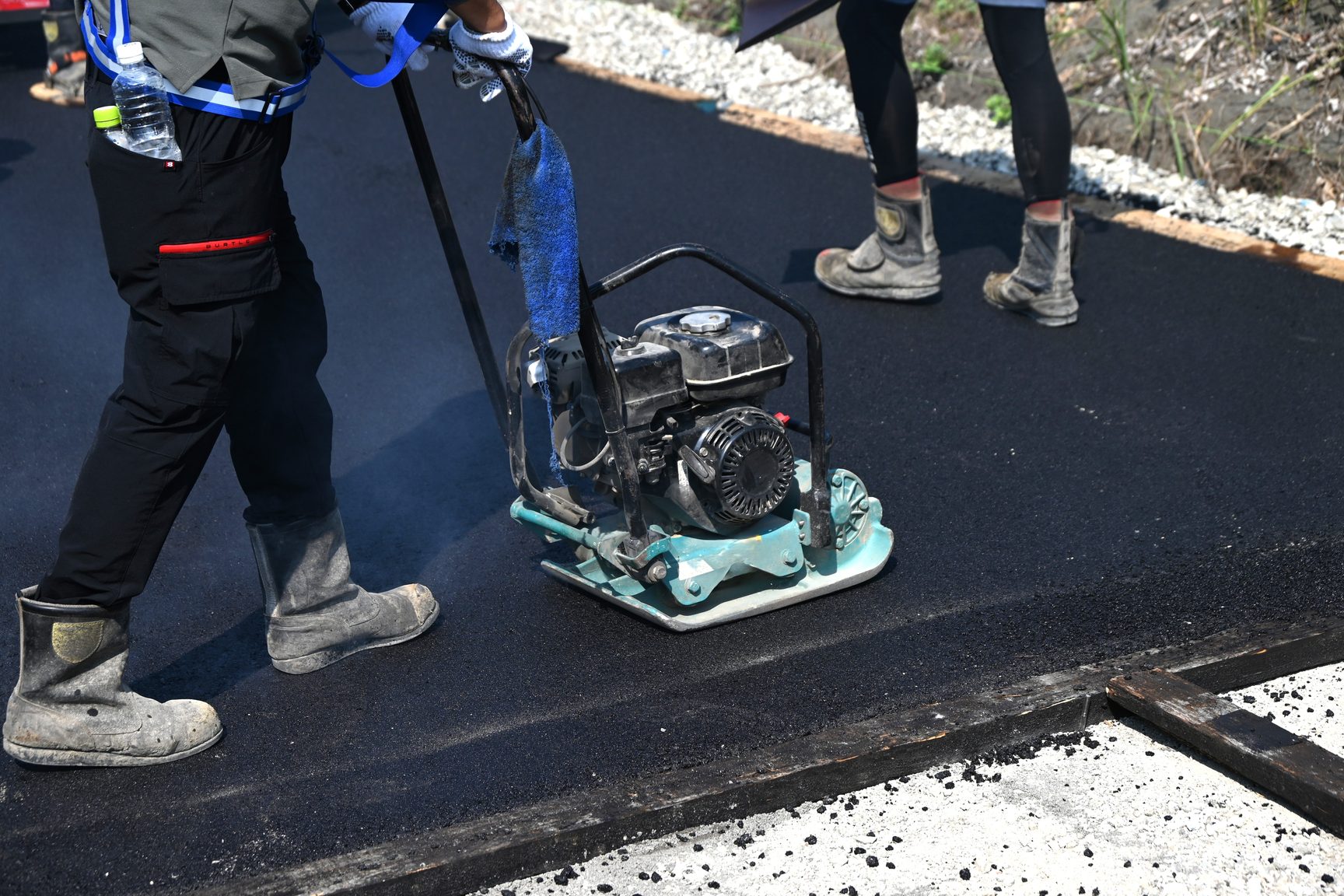
South Dakota paving contractor insurance is assembled from the lines any paving firm carries — general liability, a contractors equipment floater, commercial auto and workers compensation — and the state’s own rules mostly decide who asks to see them. South Dakota has no trade license for asphalt, sealcoating or striping work and no rule on coal-tar sealer, but it puts a tax license in front of contractors, a rating process in front of transportation department bidders, and a workers compensation law that presumes every employer is inside it.
On private lots, nearly everything that lands comes from owners and contracts; on state work, the department’s rating, its specifications and the bond law arrive before the first load of mix. The paving contractor program has to fit both kinds of week.
Electricians and plumbers hold state licenses; pavers do not
No South Dakota trade license covers putting down asphalt, sealcoating pavement or marking stalls and lanes, and the state issues no general contractor license of any kind. The contractor licenses the state does issue belong to single trades run through the Department of Labor and Regulation, such as electrical and plumbing work, and South Dakota’s electrical licensing chapter frames that contractor’s work around installing electrical wiring and apparatus, a scope that never reaches a paved surface.
Skipping a trade exam does not mean skipping state paperwork. A paving or sealing firm working on real property must apply to the South Dakota Department of Revenue for a contractor’s excise tax license, which is a tax account rather than a credential of skill, and on highway projects the tax chapter counts a striping crew hired by the prime as a subcontractor. Cities hold their own licensing power, but the statute that grants it lists plumbers, electricians, heating and air conditioning contractors and residential contractors, and names no paving trade, so any local requirement has to be checked with the city that governs the site.
Authority SDCL 10-46A-15; SDCL 10-46A-2.1; SDCL 9-34-12; SDCL 36-16-2(3) · read the source · checked
The state licenses single trades through the South Dakota Department of Labor and Regulation, and none stretches to a parking lot. What a paving firm owes instead is a tax registration, framed by taxable receipts rather than skill:
“Every contractor or person engaging in a business in this state whose receipts are subject to tax under this chapter shall file with the Department of Revenue an application for a contractor's excise tax license.”
Read that as an accounting duty. The license the South Dakota Department of Revenue issues opens a tax account and vouches for nothing about the work. On highway jobs, the tax chapter also sorts line work done for a prime into the subcontractor column:
“For highway construction projects, a subcontractor includes any person contracting with a prime contractor to perform any of the following services as part of the project: traffic control, striping, flagging, operation of pilot cars, signing, landscaping, seeding, sodding, mulching, and erosion control.”
That settles a striping crew’s tax position and says nothing about coverage; what the prime wants the crew to carry is set in the subcontract, and the striping program has to answer it before the crew mobilizes.
Local government is the other possible source of a license, and the statute granting that power names its trades:
“A municipality may license, tax, and regulate plumbers, electricians, electrical workers, residential contractors and heating, ventilation, and air conditioning contractors.”
Paving is not on that list, and nothing here describes what any city has done with the power. Ask the city where the lot sits whether it wants a right-of-way permit, a registration or proof of coverage. When it asks for a certificate naming the city, the general liability policy should be able to add it without holding up the schedule.
South Dakota law is silent on coal-tar sealer
Coal-tar pavement sealer appears nowhere in South Dakota’s Codified Laws or its Administrative Rules. The state has set no ban on the product, no limit on the surfaces it may cover and no labeling duty for it, and no rule addresses sealers high in polycyclic aromatic hydrocarbons by any other name.
Because the state layer is blank, the decision about which sealer a crew may spread belongs to the documents and local rules around the job. This research verified no South Dakota city or county ordinance on sealant, so a crew confirms the product against what the property owner has specified, what the bid documents call for and any municipal code covering the site before it goes down.
Authority South Dakota Codified Laws and Administrative Rules of South Dakota, each swept in full · read the source · checked
Silence here is a finding, not a hole in the research: the state’s statutes and rules were each swept for the product. So the sealer question moves into the paperwork, where an owner’s specification, a bid package or a city rule can name what goes down. Read the specification before the tank is filled, not after the lot is coated.
What a sealcoating crew needs from its policies does not change with the product. A misted windshield in the next row, black footprints across a lobby, a curb line that bled into a gutter: each becomes a claim against the firm whichever sealer caused it, and the sealcoating program is written for exactly those. A release that reaches a storm sewer is the case to ask about in advance, because the policy wording, not the state, decides whether it is handled as a liability loss or a pollution loss.
The South Dakota Department of Agriculture and Natural Resources is the state’s environmental agency, and the place to recheck before a large season of lot work.
Bidding SDDOT: a work classification and a capacity rating
To bid most South Dakota Department of Transportation construction contracts, a firm first needs a work classification and a maximum bidding capacity rating from the department’s Classification and Rating Committee. The applicant files a prequalification statement describing its equipment, organization, prior experience and any suspension or debarment, and backs it with either a surety’s certification of bonding coverage or an audited statement of financial position. Among the rule’s types of work are asphalt concrete paving with microsurfacing, asphalt surface treatment and crack sealing, and signing, delineation and pavement marking. Contracts below a bid amount the rule prints need no rating.
The rating carries no insurance condition, but surety is built into it: when a surety certification is used, the bonding coverage the surety will write caps the firm’s capacity and the largest single bid it may submit. Coverage and bonds then attach to the contract. SDDOT’s specifications require general liability, automobile and workers’ compensation coverage from companies authorized in South Dakota, with the State and the department as additional insureds, before work starts, plus the bid guaranty the letting calls for and a performance bond for the full contract amount at signing; the state’s public improvement bond law separately requires surety for performance and for paying labor and material suppliers before work on a public improvement begins.
Authority SDCL 31-5-10; ARSD 70:07:02:03, 70:07:02:04, 70:07:02:08, 70:07:02:09; SDCL 5-21-1; SDDOT Standard Specifications for Roads and Bridges · read the source · checked
The statement a firm files to the South Dakota Department of Transportation asks for much of what an underwriter asks for:
“To obtain or renew a work classification and maximum bidding capacity rating a prospective bidder shall submit a prequalification statement to the committee, on a form approved by the department. In the prequalification statement, the prospective bidder shall include a description of the prospective bidder's equipment, organization, prior experience, and any suspension or debarment or proposed suspension or debarment by any governmental agency.”
Equipment, organization and experience are also the core of a contractors equipment floater application, so the machine list filed with the committee and the schedule on the policy should agree line for line. The classifications that describe this trade, as the department prints them:
A surety sets the ceiling on what a firm may bid
The rating asks nothing about insurance, but it does lean on a surety. When a firm backs its statement with a surety certification, the rule ties its capacity to what that surety will write:
“If a certification of surety is furnished in accordance with subdivision 70:07:02:04(1), then the maximum bidding capacity rating may not exceed the maximum bonding coverage for all the prospective bidder's work; and the prospective bidder may not submit a bid for more than the maximum bonding coverage for a single contract.”
That makes bonding capacity a planning question. A surety underwrites the balance sheet and the work on hand, not a claims history, so the time to widen capacity is between seasons, well ahead of the letting a firm wants to reach.
Insurance and bonds attach at the contract
Insurance enters after award, through the department’s specifications, and those specifications are particular about who may write it:
“All insurance policies must be issued by a corporation qualified and authorized to write the policies in the State of South Dakota.”
A policy from an insurer without that authority fails the sentence however good its terms. The department also wants the State and the department itself shown as additional insureds, so the general liability and commercial auto policies need that wording in place before the start date rather than negotiated after it.
Surety returns through the public improvement bond law, which reaches public owners beyond the department:
“Except as provided in § 31-12-15, when any contract is entered into for the construction of public improvement or the furnishing of any material or labor therefor, the contractor is required, before commencing such work, to furnish surety in an amount not less than the contract price, for the faithful performance of the contract, with the additional obligation that the contractor shall promptly pay all persons supplying him with labor or material in the prosecution of the work provided for in the contract.”
It protects the owner if the job stalls and the suppliers of labor and material if payment stops. Its opening words point to another section of the code, so on any public job the bid documents settle which bond that owner requires.
Workers compensation: a presumption in the statute, a recommendation from the department
Under South Dakota’s compensation title, employers and employees are presumed to be bound by it, and a covered employer is told to secure payment of benefits in one of the ways it lists: insurance written by a stock corporation, a mutual employers’ liability association or a reciprocal exchange authorized in South Dakota, or proof to the Department of Labor and Regulation that the employer is solvent enough to pay benefits itself. No state-run fund sells the coverage, and the Department’s own page says no South Dakota law requires any employer to carry the insurance.
Going without it is treated as a choice with a cost. An employer that has not secured compensation is deemed to have elected not to operate under the compensation title, and its injured worker may then either sue it at law for damages or claim against it under the title at an increased benefit level; the Department recommends coverage to avoid civil suits. On a contract job, a principal or intermediate contractor is also liable for compensation to an injured employee of its subcontractor to the same extent as the immediate employer, where the injury happens on premises where the principal contractor has undertaken the work or that are otherwise under its control.
Authority SDCL 62-3-3; SDCL 62-5-1; SDCL 62-5-2; SDCL 62-5-3; SDCL 62-5-5; SDCL 62-5-7; SDCL 62-3-11; SDCL 62-3-10 · read the source · checked
The compensation title and the labor department describe the obligation from opposite ends, and a paving employer should hear both. The statute begins from a presumption:
“Every employer and employee shall be presumed to have accepted the provisions of this title, and shall be thereby bound, whether injury or death resulting from such injury occurs within this state or elsewhere, except as provided by §§ 62-3-4 to 62-3-5.1, inclusive.”
It then attaches a consequence to an employer that has not secured payment:
“Any employer other than the state, a municipality, or other political subdivision of this state, who has failed to comply with the provisions of §§ 62-5-1 to 62-5-5, inclusive, shall be deemed to have elected not to operate under the provisions of this title.”
The department’s own page states the position in its own words:
“There is no law in South Dakota requiring any employer to carry workers’ compensation insurance. However, it is highly recommended. An uninsured employer may be sued in civil court by an injured worker.”
Both appear here because the record carries both, and this page does not choose between them. What neither leaves in doubt is where a firm without coverage ends up: the injured worker, not the employer, picks between a lawsuit and a claim at the higher benefit level the finding above describes.
The same title reaches up a contract chain:
“A principal, intermediate, or subcontractor is liable for compensation to any employee injured while in the employ of any subcontractor and engaged upon the subject matter of the contract, to the same extent as the immediate employer.”
On a site the prime controls, an uninsured sub’s injured employee can become the prime’s claim, so collect a current certificate from every sub before it unloads. The workers compensation page covers how subcontractor certificates, a working owner and payroll split among paving, sealing and striping are handled on the policy. Coverage is bought in a competitive market that the South Dakota Division of Insurance, Department of Labor and Regulation regulates, and no state fund sells it.
South Dakota agencies behind each part of this page
Each office below handles a separate piece of a paving business, and none of them handles all of it:
South Dakota paving markets by SDDOT region
The transportation department organizes its road work into regions and describes each one by the counties it covers. Every market below carries its county and region from that list and nothing more; no population or mileage figure belongs here.
Sioux Falls
Minnehaha County. SDDOT Mitchell Region.
The region serving this county carries another city’s name. A crew here can move from a retail lot to a city street to a state route in the same week, and each of those owners writes its own insurance terms into the job.
Rapid City
Pennington County. SDDOT Rapid City Region.
The region takes this city’s name. A contractor based here that follows work across the region keeps loaded trailers on the road between jobs, and that road time is commercial auto exposure rather than general liability.
Aberdeen
Brown County. SDDOT Aberdeen Region.
The region is named for this city and also takes in Watertown’s county, so a firm working both markets deals with the same regional office on state work while each city keeps its own local terms.
Watertown
Codington County. SDDOT Aberdeen Region.
Listed under a region named for a different city. Before the first job inside city limits, ask the city what it expects of a paving contractor; the state-level answer on licensing does not settle the local one.
Mitchell
Davison County. SDDOT Mitchell Region.
The region takes this city’s name and also covers the county Sioux Falls sits in. A firm working both markets deals with the same regional office on state jobs, while every private owner still sends its own certificate request.
Pierre
Hughes County. SDDOT Pierre Region.
The region takes this city’s name. Public work here can come from the state, the county and the city, each under its own contract, and a certificate written for one owner rarely fits the next without new wording.
What sets the price of a paving program in South Dakota
What moves the price of a paving program — the mix of paving, sealcoating and striping work, the payroll and loss history behind it, and how workers compensation is bought — is set out in our national guide to what paving contractor insurance cost depends on. This page keeps to South Dakota’s rules, agencies and markets.
Where South Dakota paving claims tend to start
Sealer on someone else’s property. A driver slips past the cones, crosses a coat that has not set and carries it home on the tires, or a gust lifts spray onto a row of parked cars. The general liability page explains how damage to other people’s property is separated from redoing your own work.
A fall on a lot still in use. Tenants and shoppers step around barricades to reach a door, and a stumble on a fresh edge or a wet line becomes a bodily injury claim that the property contract may already have shifted onto you through its indemnity clause.
A crew injury at a firm with no coverage. In South Dakota that worker chooses the forum, a courtroom or the compensation title at the higher benefit level. It is the plainest case for placing coverage before the season rather than after a first burn.
A subcontractor’s employee hurt on your job. Under the statute quoted above, that injury can reach the prime as if it had hired the worker directly, which is why the certificate file matters as much as the policy.
South Dakota: Contractor license, no statewide license reaches this work, connected to the General Liability page. Coal-tar sealant, no state rule on the product, connected to the Asphalt Sealcoating Insurance page. Transportation department prequalification, applies to department road work, connected to the Commercial Auto page. Workers’ compensation, not compulsory for every employer, connected to the Workers Compensation page. The diagram pairs each state rule with the page on this site that discusses it and shows no figures.
Nearby states we also write
South Dakota’s neighbors in our licensed footprint each have their own page, built from their own verified record. The tax license, the bidding rating and the workers compensation rules described here are South Dakota’s alone, and none of them should be assumed to hold on the far side of a state line.
Related coverage and services
What we insure
Coverage lines
Outside authorities
- South Dakota Division of Insurance, Department of Labor and Regulation
- South Dakota Department of Transportation
- South Dakota Department of Agriculture and Natural Resources
- Division of Labor and Management, South Dakota Department of Labor and Regulation
- South Dakota Department of Labor and Regulation
- South Dakota Department of Revenue
South Dakota paving contractor insurance questions
Does South Dakota license asphalt or sealcoating contractors?
No state trade license reaches that work. The licenses the state issues cover single trades such as electrical and plumbing. What a paving firm doing work on real property does owe is a contractor’s excise tax license from the South Dakota Department of Revenue, which registers the business for a tax and says nothing about its skill. Cities keep their own licensing power, so ask each city before the first job there.
Is coal-tar sealer allowed in South Dakota?
No state statute or administrative rule restricts it, requires a label for it or limits where it may go, and no rule reaches high-PAH sealers under another name. No city or county rule on sealer was verified either. That leaves the choice to the property owner’s specification, the bid documents and whatever the local code says, so check each of them before a crew sprays.
What does an SDDOT capacity rating take?
A prequalification statement filed with the department’s rating committee, covering the firm’s equipment, organization, experience and any suspension or debarment, and backed by a surety’s certification or a statement of its financial position. The department then sends a notice setting out the approved work classifications, the overall and per-contract capacity and the expiration date. Contracts below an amount the rule prints can be bid without a rating.
Does the SDDOT rating depend on my insurance?
No. The rating rule sets no insurance condition. Insurance arrives with the contract: the department’s specifications call for general liability, auto and workers compensation from insurers authorized in the state, naming the State and the department as additional insureds before work begins. A surety can shape the rating, though, because capacity backed by a surety certification cannot exceed the bonding that surety will write.
Do I have to carry workers compensation in South Dakota?
The sources answer from different sides. The statute presumes every employer and employee accept the compensation title and directs a covered employer to secure payment of benefits. The labor department says no state law obliges an employer to buy the insurance, and recommends it. An employer without it is treated as having elected out of the title, and its injured worker may then sue it in court or claim higher benefits under the title.
Can a subcontractor’s injured worker become my claim in South Dakota?
Yes, it can. South Dakota makes a principal or intermediate contractor answer for compensation to a subcontractor’s injured employee as if it were that worker’s direct employer, when the injury happens on premises the principal has taken on or otherwise controls. Collecting a current certificate from each sub before it mobilizes is how a prime keeps that claim with the sub’s own insurer.
How does South Dakota treat a striping crew hired on a highway job?
For tax purposes, the excise tax chapter counts a firm hired by the prime for striping, traffic control or signing on a highway project as a subcontractor. That is a tax classification only, not a license and not an insurance rule. What the crew has to carry is written into its subcontract with the prime, so read that document before the first stripe goes down.
This page describes insurance for paving and asphalt contractors operating in this state. It is general information, not legal advice and not a statement of coverage. Licensing, permitting and environmental requirements change; verify current requirements with the agency named before relying on them.
Get a quote for your South Dakota paving work
Tell us whether your South Dakota work is private lots, city streets or department lettings, and we will match the program to the contracts and certificates each one brings.