
Paving Contractor Insurance by State
North Dakota Paving Contractor Insurance
North Dakota ties the paving license to proof of liability coverage, sells workers compensation only through the state, and asks NDDOT bidders to prequalify every year.
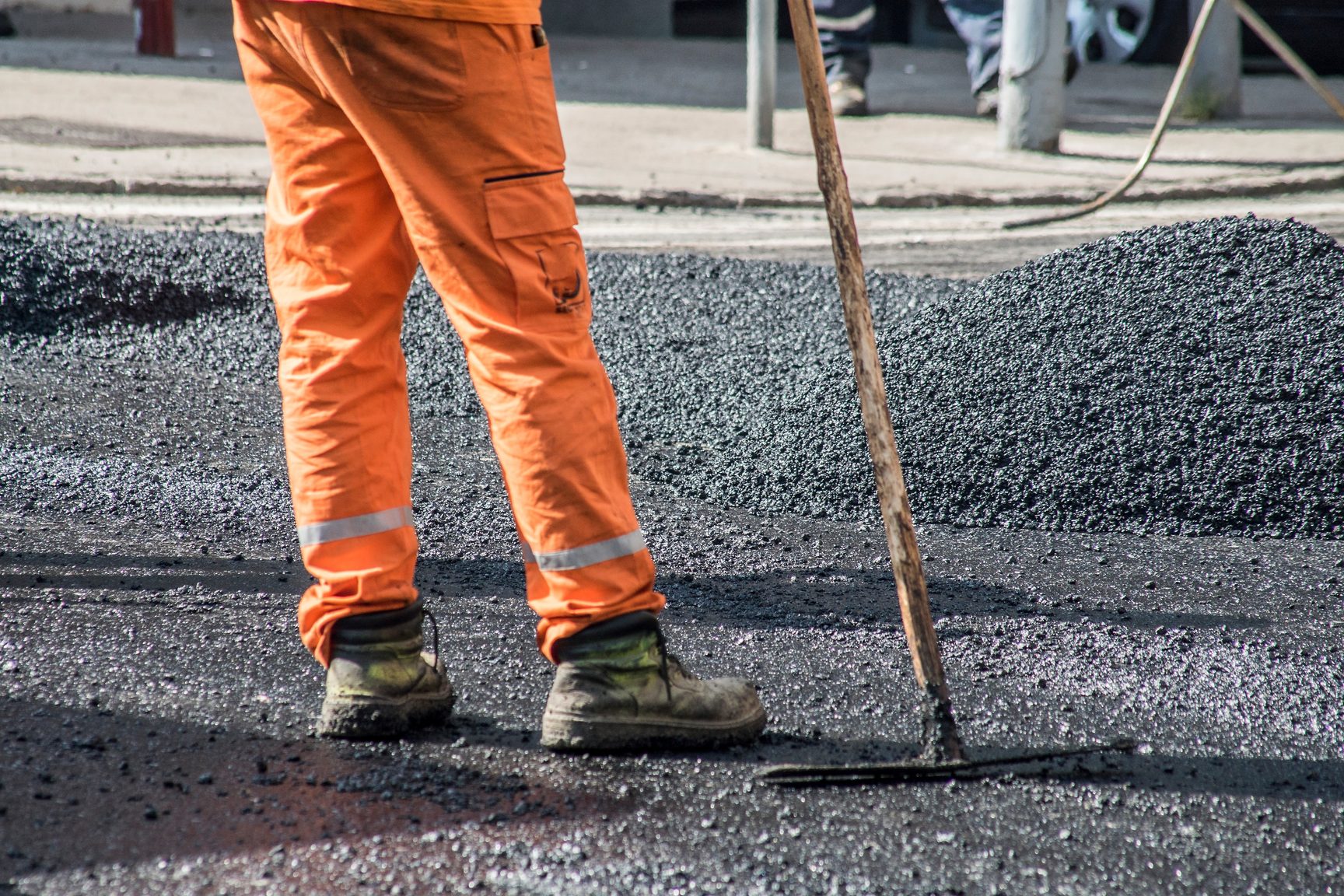
For a North Dakota paving, sealcoating or striping business, general liability, contractors equipment, commercial auto and property coverage are bought from insurers, while workers compensation comes only from the state, through the North Dakota Workforce Safety & Insurance, because the law leaves no private market for it. What sets the state apart after that is how tightly the insurance is tied to the license: the Secretary of State wants a liability certificate and a coverage statement from that same agency before licensing a contractor, and the department of transportation will not sign a road contract until the bidder holds that license and that state coverage.
The result is a chain of paperwork a crew meets in roughly the same order every season: the state compensation account, then the liability certificate filed with the license, then, for public road work, the department’s yearly prequalification and its surety demands. Private lots, apartment drives and church parking areas skip the department’s layer, but not the license, once a job’s price clears the level the chapter sets. The sections below take those layers in turn.
A North Dakota contractor license sized by contract value, with insurance on file
North Dakota licenses contractors through its Secretary of State, and the licensing chapter reaches this trade directly: it counts as a contractor anyone in the business of building, repairing or altering highways, roads, streets and every other improvement to real or personal property. The license is not divided by trade, so sealcoating and lot striping, which the chapter never names, fall under its repair and improvement wording; what varies is the license class, and only the class A license carries no limit on the value of a single contract project.
Insurance paperwork travels with the license. An applicant files a certificate of liability insurance plus a statement from Workforce Safety & Insurance showing coverage the agency accepts, and the Secretary of State marks a license not in good standing when that liability coverage lapses. Acting in a contractor’s capacity unlicensed, once a job’s price passes the figure the chapter prints, is a crime graded class A misdemeanor, and it bars the firm from pressing any court claim tied to its contracting; below that figure the chapter asks for no license.
Authority N.D.C.C. 43-07-01(1); N.D.C.C. 43-07-02(1) and (2); N.D.C.C. 43-07-04(1) and (3)(a); N.D.C.C. 43-07-07(1)(a) · read the source · checked
Sealcoating and lot striping come in through the chapter’s repair and improvement wording, so a sealing-only or striping-only operation should plan on holding the same license a paving outfit holds. The trigger is the price of a job, and the same sentence takes away the unlicensed contractor’s standing in court:
“A person may not engage in the business nor act in the capacity of a contractor within this state when the cost, value, or price per job exceeds the sum of four thousand dollars nor may that person maintain any claim, action, suit, or proceeding in any court of this state related to the person's business or capacity as a contractor without first having a license as provided in this chapter.”
The lost court claim is the consequence that costs money, because a contractor barred from suing over an unpaid balance has lost the ordinary way of collecting on a finished lot. The class that fits is a question of the largest single job the business expects to sign; the limits on each class and the fees are set in the chapter and are not repeated here. Insurance enters at the application and stays attached to the license afterward:
“A copy of a certificate of liability insurance must be filed with the application and the contractor shall submit a statement from North Dakota workforce safety and insurance that the contractor has secured workforce safety and insurance coverage satisfactory to workforce safety and insurance.”
“the registrar shall classify as not in good standing the license of any contractor who fails to: a. Maintain liability insurance coverage required by this section or by section 43-07-10;”
That turns the certificate into a live document. If the policy lapses or is canceled mid-term, the license’s standing goes with it, so the renewal date on the general liability program belongs on the same calendar as the license renewal.
Pavement sealer in North Dakota: no statute and no rule
No North Dakota statute or administrative rule speaks to coal-tar pavement sealer or to sealers rich in polycyclic aromatic hydrocarbons. The state has barred neither the sale nor the use of such a product, confined it to no particular surface and imposed no labeling duty, and the lone coal-tar passage in the Century Code is a hair-dye labeling provision.
With the state out of it, the sealer on a given North Dakota lot is picked job by job. This record read no sealer ordinance from any city or county in the state, so the owner’s written requirements, the contract package and the ordinances of whichever city or county governs the site settle which product may go down. The one Administrative Code rule that names cutbacks lists them among the surface treatments that can hold down dust on unpaved roads and unpaved parking areas, which permits a use rather than restricting a pavement product.
Authority North Dakota Century Code and North Dakota Administrative Code, both swept in full; N.D.C.C. 19-02.1-17; N.D. Admin. Code 33.1-15-17-03(1) · read the source · checked
The nearest the administrative rules come to a pavement product runs the other way. A rule aimed at dust from unpaved roads and lots lists cutbacks among the treatments that can hold it down:
“Abatement and preventive measures include frequent watering, addition of dust palliatives, detouring, paving, closure, speed control, or other means such as surface treatment with penetration chemicals (ligninsulfonates, oil, water, cutbacks, etc.) or methods of equal or greater effectiveness in reducing the air contamination produced.”
That permits a use on a surface that is not paved and sets no limit on what may go over a finished lot. The specification is where a crew learns what goes down, and no local sealer ordinance was read for this page, which makes local rules a gap in what was checked rather than a finding that none exist. On the insurance side the product matters less than where it travels. Sealer tracked into a lobby, overspray on a tenant’s car and a rinse that reaches a ditch are the losses a sealcoating program is built around, and whether that ditch counts as a liability claim or a pollution claim is a question for the policy form.
Bidding NDDOT work: yearly prequalification, a license at signing, then surety
The North Dakota Department of Transportation considers proposals only from bidders it has prequalified, a condition set in its standard specifications for road and bridge construction, and it requires the prequalification statement again every year. The highway statute gives the director power to adopt bidding procedures and rules and refers to the qualified contractors on the department’s bidders’ list.
Prequalifying is a separate gate from the state license, and neither the department’s bid information page nor its specification on bidder qualification asks for an insurance policy. A bidder may submit a proposal without a Secretary of State contractor license, but the department signs a contract only with a bidder that holds the license and has secured coverage from Workforce Safety & Insurance. Surety comes with the bid and the award: a proposal carries an annual bid bond, a single-project bid bond or a certified or cashier’s check, and the specifications call for a contract bond equal to the original contract amount. By statute the winning bidder on a contract above the size the highway chapter sets must furnish a bond at least equal to the contract, while smaller jobs may be let on informal bids on whatever terms the director directs.
Authority NDDOT Standard Specifications for Road and Bridge Construction, Sections 102.01, 102.02, 102.09 and 103.05; N.D.C.C. 24-02-17; N.D.C.C. 24-02-19(3); N.D.C.C. 24-02-21; N.D.C.C. 24-02-23 · read the source · checked
“The Department will only consider a proposal from a prequalified Bidder.”
Nothing in that published requirement asks for an insurance policy. Insurance shows up at signing instead, and the department’s bid page says so in plain terms:
“However, prior to the execution of a contract, a bidder MUST have obtained the appropriate North Dakota contractor's license and secured workers’ compensation coverage from Workforce Safety & Insurance.”
So the chain from the licensing section reappears in a different order. The North Dakota Department of Transportation will read a proposal from a prequalified bidder that has no license yet, then decline to sign until the license and the coverage are in place, which is why both are best settled before a bid opens. The department prints the kinds of work it prequalifies, and much of this trade appears on that list in its own words:
Seal coats, crack sealing and pavement marking sit on the same list as hot mix, so the step is not reserved for paving firms. A company bidding across those work types tends to run a wide spread of machines, from milling heads to striping rigs, and each belongs on the contractors equipment floater before it rolls onto a department job.
Bonds under the highway chapter
The highway chapter sets its bond rule in two halves. Above a contract size the chapter fixes, the successful bidder furnishes a bond at least equal to the contract; smaller jobs can go out on informal bids, with the basis for the award left to the director:
“The successful bidder must be required to furnish a suitable bond in at least the amount of the contract and with such surety as may be determined by the department and as approved by it.”
“Informal bids must be requested and the contract therefor may be awarded upon such basis and procedure as the director directs.”
Surety credit rests on the balance sheet and the backlog, and it protects the department, not the contractor; if the surety pays, it looks to the contractor to repay it. That conversation belongs in the off-season, alongside the license renewal and the prequalification statement.
North Dakota workers compensation is bought from the state alone
Workers’ compensation in North Dakota is a state monopoly with no private market and no self-insurance route. Workforce Safety & Insurance describes itself as the sole provider and administrator of the coverage and says state law bars private insurers from underwriting it, and the statute has each covered employer pay its premium into the workforce safety and insurance fund, which the state treasurer holds, and forbids putting anyone to work in hazardous employment before applying to WSI for coverage.
A paving, sealcoating or striping business with employees falls inside the compulsory layer. The statute treats employment as hazardous as soon as a business regularly employs someone, and its exceptions reach agricultural and domestic service, railroad common carriers, short in-state hauls by nonresidents and religious organizations’ place-of-worship staff, not construction work. Coverage for an owner is elective, and a general contractor, together with any subcontractor that passed the work down, owes the premium and any penalty for the workers of a subcontractor or independent contractor that fails to secure coverage, limited to work done under that general contractor.
Authority N.D.C.C. 65-01-02 (Hazardous employment; Fund; Organization); N.D.C.C. 65-04-04(1); N.D.C.C. 65-04-30; N.D.C.C. 65-04-33(1); N.D.C.C. 65-04-26.2(1) · read the source · checked
“North Dakota law does not allow private insurers to underwrite workers' compensation insurance in North Dakota.”
The statute enforces the arrangement at the start of employment rather than after an injury:
“An employer may not employ any person, or receive the fruits of the labor of any person, in a hazardous employment as defined in this title, without first applying for workforce safety and insurance coverage for the protection of employees by notifying the organization of the intended employment, the nature of the intended employment, and the estimated payroll expenditure for the coming twelve-month period.”
Owners are handled differently, and whether one who runs the paver should elect is a decision for the planning months; the workers compensation page walks through how that choice sits beside the rest of the program:
“With the exception of federal and railroad employees, an employer may choose to purchase elective coverage for himself/herself and for any employees otherwise exempt.”
Subcontracting carries a liability of its own:
“A general contractor and a subcontractor are liable for payment of premium and any applicable penalty for an employee of a subcontractor or independent contractor that does not secure required coverage or pay the premium owing.”
A prime that brings in a sealing or striping sub should see that sub’s current coverage statement before the sub mobilizes. For the rest of the program the picture is simple: liability, auto, equipment and property are placed with insurers, and the compensation account is opened and kept with the state. A private policy does not stand in for it, and a quote that folds North Dakota employees into one deserves a hard second look.
The North Dakota offices a paving business answers to
North Dakota paving markets that share a name with an NDDOT district
Each card gives the county the city sits in and links the department’s page on its districts; no population, mileage or market-size figure is attached.
Fargo
Cass County. Fargo.
Street, lot and apartment work can fall in the same week, and each owner may want its own additional insured wording on the certificate. Keep a current certificate ready for each kind of owner.
Bismarck
Burleigh County. Bismarck.
A firm bidding department work meets the prequalification renewal, the license and the state compensation account on a single calendar. A gap in any of them stops a contract at signing.
Grand Forks
Grand Forks County. Grand Forks.
Sealing and striping on private lots are rated differently from laying hot mix, so describe each accurately at renewal rather than folding the whole operation into a paving line.
Minot
Ward County. Minot.
Trailer moves between distant jobs put trucks and machines on public highways, and every unit that makes the trip belongs on the auto schedule and the equipment schedule.
Williston
Williams County. Williston.
When a prime brings in a sealing or striping subcontractor, that sub’s current coverage statement from the state belongs in the job file before the sub mobilizes.
Dickinson
Stark County. Dickinson.
A job priced above the chapter’s license trigger needs the license in hand before work starts, whichever district the lot falls in and whoever the owner is.
What shapes the price of a North Dakota paving program
What moves the price of a paving program — the mix of paving, sealcoating and striping work, the payroll and loss history behind it, and how workers compensation is bought — is set out in our national guide to what paving contractor insurance cost depends on. This page keeps to North Dakota’s rules, agencies and markets.
Losses that turn up on North Dakota paving and striping jobs
Sealer carried off the job. Tires and shoes take fresh sealer onto a sidewalk, an entry mat or a garage floor, and the cleanup bill arrives at the contractor; the general liability page explains where that claim sits.
Paint where it was not meant to go. Striping overspray drifts onto parked vehicles or a storefront, usually on a breezy day with the lot still partly open.
Traffic beside a road job. A driver who clips a barrel line or a flagger brings the traffic control setup into the claim, and the road owner’s contract often decides who defends first.
An injured crew member. A hot-mix burn, a strike from a backing roller, a strain late in a long shift. In North Dakota that claim runs through the state account, not an insurer, which is why keeping the account current matters more than any limit.
Written separately with the state fund, not placed in this program, so no connector is drawn.
North Dakota: Contractor license, a state license or registration can reach this work, connected to the General Liability page. Coal-tar sealant, no state rule on the product, connected to the Asphalt Sealcoating Insurance page. Transportation department prequalification, applies to department road work, connected to the Commercial Auto page. Workers’ compensation, bought only from the state fund, which is written separately and has no connector. The diagram pairs each state rule with the page on this site that discusses it and shows no figures.
Nearby states we also write
Each neighbor has its own page and its own verified findings, and nothing on this page crosses the border. A crew that works on both sides of a line should have every state named on the program, with the licensing and compensation questions settled separately for each.
Related coverage and services
What we insure
Coverage lines
North Dakota paving contractor insurance questions
Does a sealcoating-only business need a North Dakota contractor license?
It can. The licensing chapter sorts licenses by the value of a job rather than by trade, and it reaches repair and improvement work on real property, which is where sealing and lot striping fall even though the chapter never names them. Once a job’s price passes the level the chapter sets, the work needs a license from the North Dakota Secretary of State; at or below that level no license is required.
What insurance proof goes in with a North Dakota license application?
A liability certificate and a coverage statement. The application carries a copy of a certificate of liability insurance, and the contractor supplies a statement from the North Dakota Workforce Safety & Insurance showing coverage that agency accepts. Neither is a one-time filing: when the liability coverage lapses, the license is classified as not in good standing, so an expired or canceled policy turns into a licensing problem too.
Can we buy workers comp for our North Dakota employees from a private carrier?
No. The North Dakota Workforce Safety & Insurance is the only source of that coverage, and it says state law keeps private insurers from underwriting it. Each employer pays premium into the state fund and has to apply before putting anyone to work in covered employment, and the act offers no self-insurance route. Liability, auto, equipment and property coverage are still placed with private insurers as usual.
Do I need a state license just to submit an NDDOT proposal?
No, but you need it before the contract is signed. The department reads proposals only from bidders it has prequalified, and that status is renewed yearly; it does not ask for the state license at the proposal stage. It will not execute the contract until the bidder holds the right license and has coverage from the North Dakota Workforce Safety & Insurance, so settle both before bidding.
Is coal-tar sealer allowed on North Dakota parking lots?
The state does not restrict it. No North Dakota statute or administrative rule bans coal-tar or high-PAH pavement sealer, confines it to certain surfaces or requires a label for it. That leaves the decision to each job: the owner’s specification, the bid documents and any city or county ordinance where the lot sits. No local ordinance was read when this page was checked, so ask the city before the season.
If a subcontractor on our job has no coverage, are we responsible?
For the premium, yes. North Dakota makes a general contractor, and any subcontractor above in the chain, liable for the premium and any penalty on the workers of a subcontractor or independent contractor that has not secured coverage, limited to work done under that general contractor. Asking a sealing or striping sub for its current coverage statement before it mobilizes is the simplest protection.
Does an owner who runs the paver have to be covered?
Not automatically. The North Dakota Workforce Safety & Insurance lets an employer buy elective coverage for itself and for employees who are otherwise exempt, federal and railroad employees aside. An owner who works on the crew every day should make that choice deliberately, because an owner who never elects has no compensation coverage of their own for an injury on the job.
This page describes insurance for paving and asphalt contractors operating in this state. It is general information, not legal advice and not a statement of coverage. Licensing, permitting and environmental requirements change; verify current requirements with the agency named before relying on them.
Get a quote for your North Dakota paving work
Tell us which North Dakota lots and road jobs are on your schedule, and we will build the insured lines to sit beside your license and your state compensation account.